USAID DEC
Low-Cost Cultivation Improvements Have Big Impacts on Food Security and Resilience in Uganda
Sign inBRAC INTERNATIONAL
Low-Cost Cultivation Improvements Have Big Impacts on Food Security and Resilience in Uganda
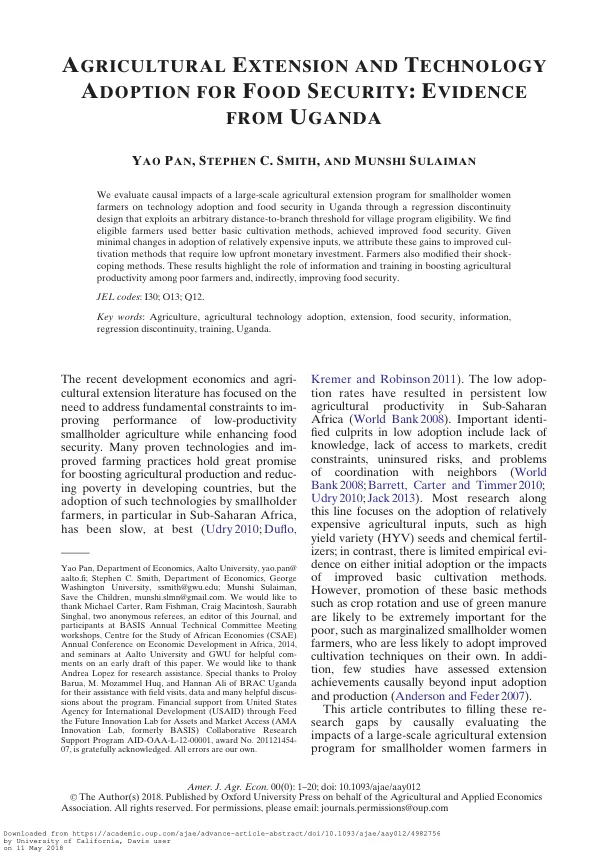
Agricultural extension programs have been implemented in various developing countries to improve food security and reduce poverty among smallholder farmers.
2018 · 2 pages
Sign in to readA free account is required to download.
Abstract
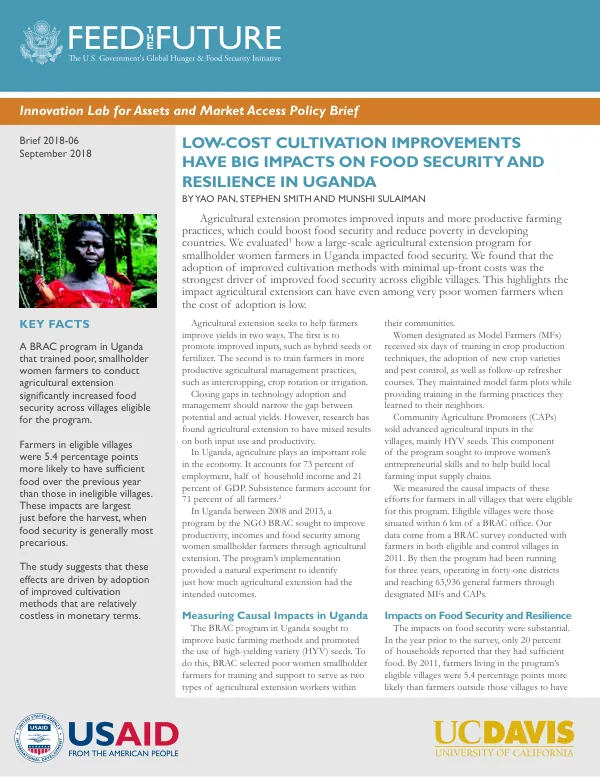
One such program was conducted in Uganda by the BRAC organization, which aimed to improve productivity, incomes, and food security among women smallholder farmers through agricultural extension. The program's implementation provided a natural experiment to identify the impact of agricultural extension on food security. The BRAC program in Uganda selected women smallholder farmers for training and support to serve as two types of agricultural extension workers within their communities. Women designated as Model Farmers (MFs) received six days of training in crop production techniques, the adoption of new crop varieties, and pest control, as well as follow-up refresher courses. They maintained model farm plots while training other farmers in the farming practices they learned. Community Agriculture Promoters (CAPs) sold advanced agricultural inputs in the villages, mainly high-yielding variety (HYV) seeds. The program's impacts on food security were substantial. Farmers living in villages eligible for the program were 5.4 percentage points more likely than farmers in ineligible villages to have sufficient food over the previous year. The impacts were largest just before the harvest, when food security is generally most precarious. Detailed surveys on consumption also showed significant improvements, with per-capita household food consumption 12 percent higher in the week prior to the survey. The agricultural program also helped farmers to better cope with shocks. In the six months prior to the survey, a little over half of households experienced at least one village shock, such as a flood or poor-quality seeds. Households in villages eligible for the program were 8.3 percentage points more likely than ineligible households to reduce consumption and 4.9 percentage points less likely to sell assets. Preserving assets after shocks has potential longer-term benefits by maintaining the capacity for future productivity and food security. The improved food security was attributed to the adoption of improved cultivation methods that require low upfront costs. Farmers in eligible villages were 9.2 percentage points more likely to use organic fertilizer, such as manure, and 3 percentage points more likely to irrigate their land using basic methods. Intercropping and crop rotation also increased by 6 and 8 percentage points, respectively. These practices mitigate soil erosion and increase yields. The results suggest that targeted agricultural extension can offer a cost-effective approach to assist poor women and their children. Agricultural extension merits greater focus in efforts to improve food security, and NGO programs can also be effective, at least for women smallholders. The BRAC program's success highlights the potential of low-cost agricultural extension to improve food security and resilience in developing countries.