USAID DEC
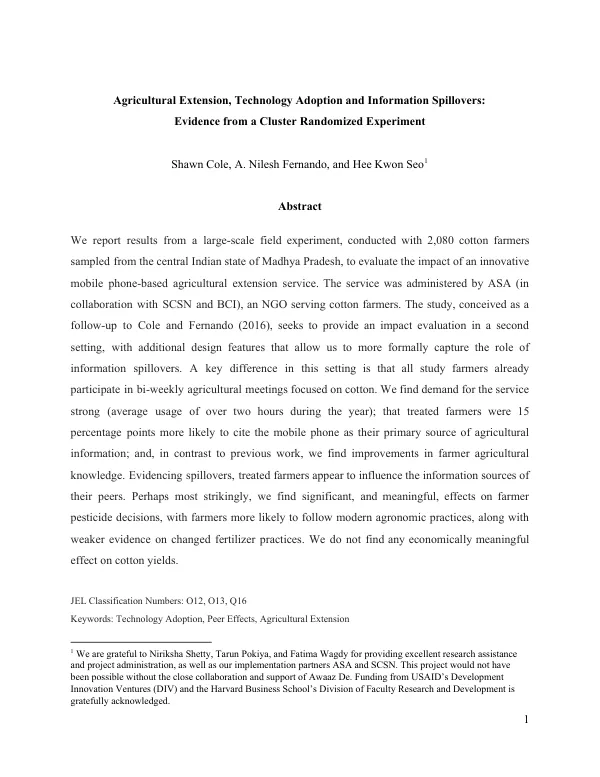
Agricultural Extension, Technology Adoption and Information Spillovers: Evidence from a Cluster Randomized Experiment
Sign inUSAID
Agricultural Extension, Technology Adoption and Information Spillovers: Evidence from a Cluster Randomized Experiment
Agricultural Extension, Technology Adoption, and Information Spillovers: Evidence from a Cluster Randomized Experiment The study was conducted in the central Indian state of Madhya Pradesh, where 2,080 cotton farmers were sampled.
2016 · 42 pages
Sign in to readA free account is required to download.
Abstract
The researchers evaluated the impact of an innovative mobile phone-based agricultural extension service, administered by ASA in collaboration with SCSN and BCI. The service was designed to provide farmers with access to agricultural information and advice through a hotline and weekly push-content. The study found strong demand for the service, with treated farmers averaging over two hours of usage per year. Treated farmers were 15 percentage points more likely to cite the mobile phone as their primary source of agricultural information. The service also improved agricultural knowledge among farmers, with treated farmers showing higher levels of knowledge compared to the control group. Furthermore, the study found that treated farmers influenced the information sources of their peers, with evidence of "indirect" information spillovers. The researchers also examined the impact of the service on farmer behavior, finding significant effects on pesticide decisions. Treated farmers were more likely to follow modern agronomic practices, and there was weaker evidence of changes in fertilizer practices. However, the study did not find any economically meaningful effect on cotton yields. The study's design allowed for the capture of information spillovers, which were found to be complex and multifaceted. While treated farmers did not share information directly with non-treated farmers in the same learning groups, there was evidence of "indirect" information spillovers, where control farmers would request their treatment peers to access the system and service questions on their behalf. Additionally, the study found that farmers in more intensely treated learning groups had lower rates of usage of the service compared to farmers in less intensely treated groups. The study's findings have implications for the design and implementation of agricultural extension services. The researchers suggest that the service could be scaled in a cost-effective manner, but that it may be difficult to sustain a demand-driven information service purely on the basis of private investment. The study's results also highlight the importance of considering the role of information spillovers in the adoption of new agricultural technologies. The study's conceptual framework and experimental design were informed by previous research on the adoption of new agricultural technologies and the role of extension services in India. The researchers drew on a range of theoretical and empirical studies, including work on the impact of incentivized extension agents and the importance of impartial advice in extension programs. The study's sample consisted of 2,080 cotton farmers in the central Indian state of Madhya Pradesh. The researchers used a cluster randomized experiment design, with farmers randomly assigned to receive the mobile phone-based agricultural extension service or not. The study's data included both direct survey data and administrative data, which provided a comprehensive picture of the impact of the service on farmer behavior and outcomes. The study's empirical strategy involved a range of statistical analyses, including regression analysis and propensity score matching. The researchers used these methods to estimate the impact of the service on a range of outcomes, including agricultural knowledge, pesticide decisions, and cotton yields. The study's results were robust to a range of sensitivity analyses and checks for potential biases. The study's conclusions have important implications for the design and implementation of agricultural extension services in India. The researchers suggest that the mobile phone-based agricultural extension service could be a valuable tool for improving agricultural productivity and reducing rural poverty. However, they also highlight the need for careful consideration of the role of information spillovers and the potential for freeriding in the adoption of new agricultural technologies.
Related documents
Documents in this collection
 2015
2015USAID DEC
The Potential Impact of Up-Front Drug Sensitivity Testing on India’s Epidemic of Multi-Drug Resistant Tuberculosis
Open record 2015
2015USAID DEC