USAID DEC
Reducing Vulnerability to Human Trafficking: Research on awareness campaigns in Nepal
Sign inLAPOP – VANDERBILT UNIVERSITY
Reducing Vulnerability to Human Trafficking: Research on awareness campaigns in Nepal
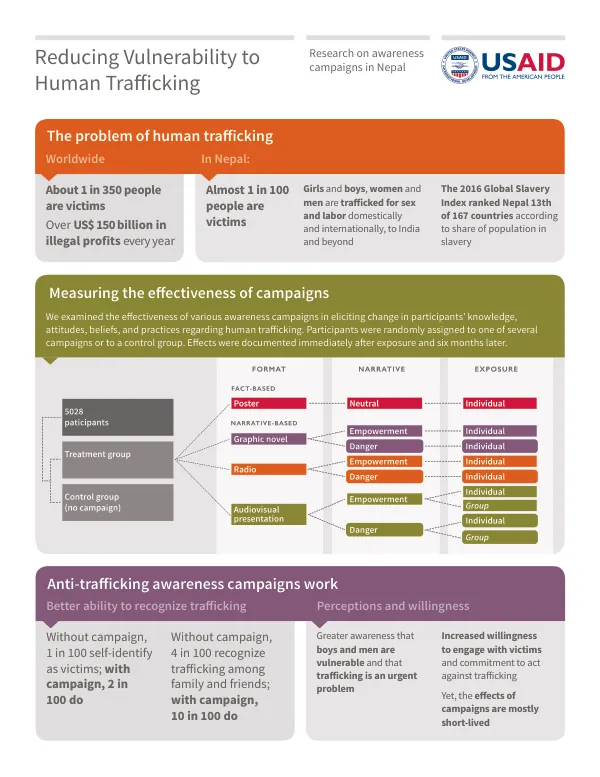
Human trafficking is a significant problem worldwide, with approximately 1 in 100 people in Nepal identifying as victims.
2016 · 2 pages
Sign in to readA free account is required to download.
Abstract
The 2016 Global Slavery Index ranked Nepal 13th among 167 countries in terms of the share of population in slavery. Human trafficking affects girls and boys, women and men, both domestically and internationally, with victims being trafficked to India and beyond. Measuring the effectiveness of awareness campaigns in Nepal is crucial to understanding how to reduce vulnerability to human trafficking. Researchers examined the impact of various campaigns on participants' knowledge, attitudes, beliefs, and practices regarding human trafficking. Participants were randomly assigned to one of several campaigns or to a control group, with effects documented immediately after exposure and six months later. The results showed that awareness campaigns can increase knowledge about human trafficking, improve attitudes toward victims, and enhance the ability to recognize cases of trafficking. The study found that radio-based campaigns are the most effective in a context like Nepal, with empowerment narratives working better than danger narratives. Individual exposure to campaigns is preferable to group exposure, as it is less costly and more efficient. The study also highlights the importance of recurrent campaigns, as the effects of awareness campaigns are mostly short-lived. Furthermore, the study suggests that narrative-based formats are more effective than fact-based, poster formats, particularly when it comes to improving attitudes toward victims. The study's findings have significant implications for designing anti-trafficking campaigns. The results indicate that empowerment narratives are more effective in improving attitudes toward victims, and that individual exposure is a more cost-effective approach. The study also emphasizes the need for repeated anti-trafficking awareness campaigns to reinforce desired changes in knowledge, attitudes, beliefs, and practices. Overall, the study provides valuable insights into the effectiveness of awareness campaigns in reducing vulnerability to human trafficking in Nepal. The study's authors, Archer, Boittin Osgoode, and Mo, conducted the research as part of the USAID, Vanderbilt University, and Institute of International Education's Research and Innovation Grants Working Papers Series. The study's findings have important implications for policymakers, practitioners, and researchers working to combat human trafficking in Nepal and beyond.
Related documents
Documents in this collection
 2021
2021USAID DEC
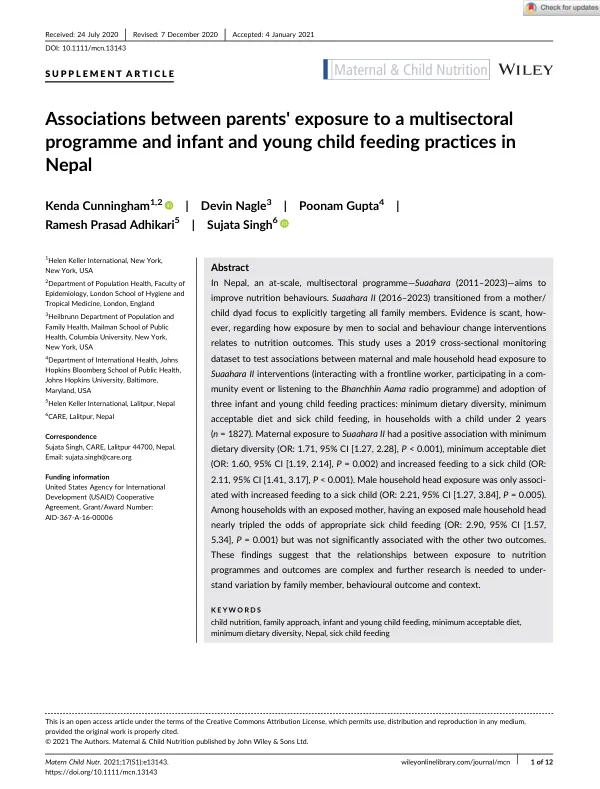
Associations between parents' exposure to a multisectoral programme and infant and young child feeding practices in Nepal
Open record 2021
2021USAID DEC