MACEDONIAN MINISTRY OF AGRICULTURE, FORESTRY AND WATER ECONOMY
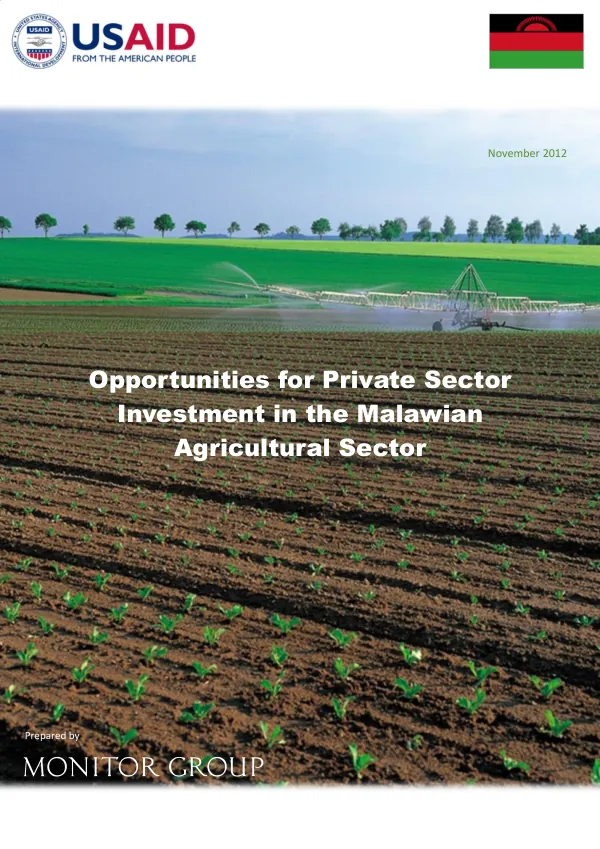
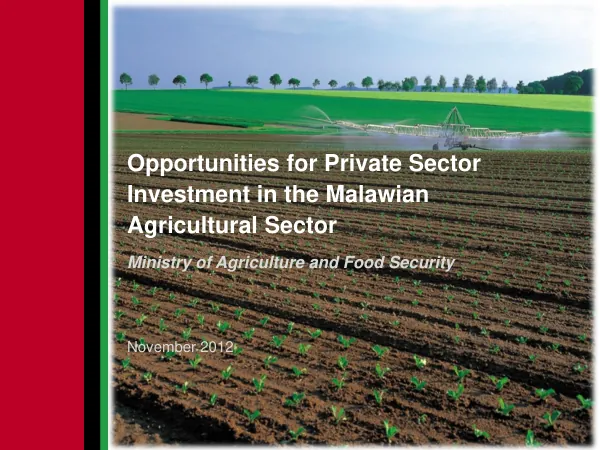
Opportunities for Private Sector Investment in the Malawian Agricultural Sector
Malawi's agricultural sector is a significant contributor to the country's economy, accounting for 30% of the country's GDP in 2011.
2012 · 75 pages
Sign in to readA free account is required to download.
Abstract
The sector's growth has been driven primarily by the agriculture sector, with the government seeking to foster a market-driven economy and attract foreign direct investment (FDI) into agriculture. Malawi's economy has experienced consistent growth between 2006 and 2011, with a 12.8% annual GDP growth rate. Malawi's currency was floated on the open market in 2012 to foster a market-driven economy, meet IMF requirements, and increase exports. In the short term, this contributed to rising inflation, but in the long term, it is expected to increase the competitiveness of exports. FDI inflows into Malawi have fluctuated but trended upwards between 2006 and 2010, with room to grow investment in agriculture, which only received 5% of committed investment in 2011. Malawi is an attractive investment destination due to its relatively abundant means of production, access to markets, and improving enabling environment for investment. The country has a strong market potential for Malawian produce, with a growing local market and accessible regional markets. Malawi's population of 15.4 million is growing at 2.9% per annum, with increasing buying power, and the country has established trade relationships with the EU and Asian countries. The government has implemented several initiatives to develop the agriculture sector, including the Agriculture Sector Wide Approach (ASWAp) and the National Export Strategy (NES). These initiatives aim to make government goals transparent and improve the enabling environment for investment through policy reforms. The government has recently passed several bills, including the Business Registration, MITC, Bureau of Standards, and PPP bills, and is currently reviewing the Secure Transactions, Business Licensing, Insolvency Bills, and the Company Law. Malawi's agricultural sector has several opportunities for private sector investment, including the production of crops such as maize, tobacco, and cotton. The country has a relatively high yield of maize, with an average yield of 2.5 tons per hectare, and a significant potential for irrigation development. The government has also identified several value chains for private sector investment, including the production of high-quality cassava flour, corn-soya blend, and green belt initiative. However, there are also several risks and mitigations associated with investing in Malawi's agricultural sector. The country faces political and regulatory risks, including the risk of policy changes and the lack of a clear regulatory framework. Financial risks include the risk of currency fluctuations and the lack of access to credit for smallholder farmers. Supply chain risks include the risk of crop failure and the lack of infrastructure to support agricultural production. Market risks include the risk of fluctuations in global commodity prices and the lack of access to markets. To mitigate these risks, the government has implemented several strategies, including the development of a unified strategy for the agriculture sector, the improvement of the enabling environment through policy reforms, and the support and co-investment in turnkey projects. The government has also established several institutions to support agricultural development, including the Malawi Bureau of Standards, the Malawi Investment and Trade Commission, and the Savings and Credit Cooperatives.