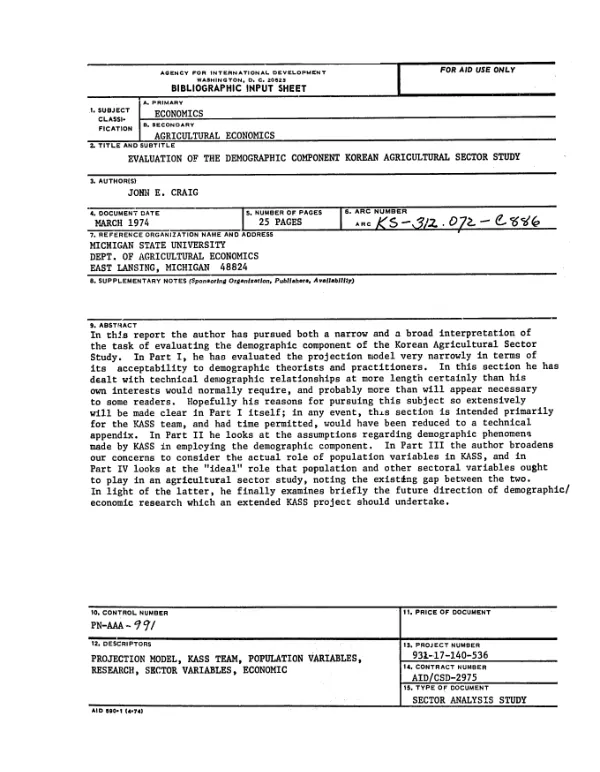
MICHIGAN STATE UNIVERSITY. DEPT. OF AGRICULTURAL ECONOMICS
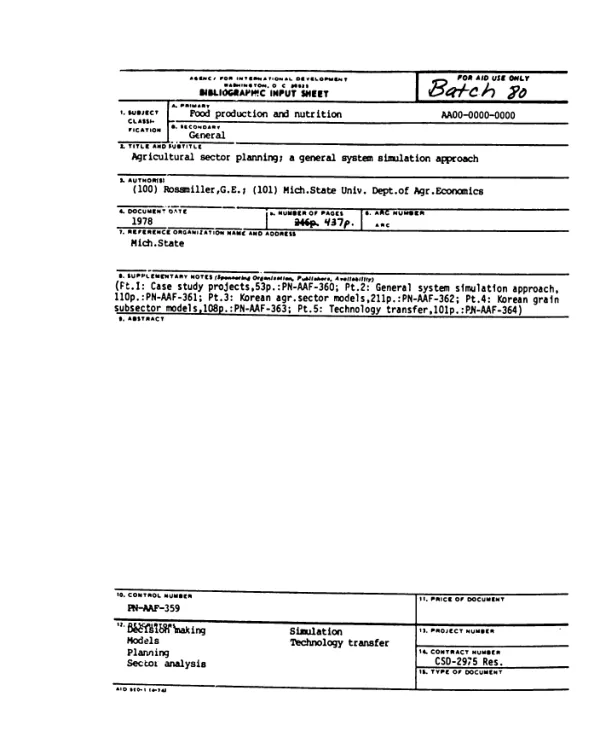
AGRICULTURAL SECTOR PLANNING; PART III : THE KOREAN AGRICULTURAL SECTOR MODELS
Part III of the Agricultural Sector Planning Report presents a brief description of the physical characteristics, the socioeconomic structure, and the institutional setting of the Korean agricultural sector.
ROSSMILLER, GEORGE E. · 1970
Sign in to readA free account is required to download.
Abstract
This is followed by an overview of: the perspective and values held by Korean decision makers with respect to the agricultural sector and its relation to the national economy; the general set of problems that has determined the scope of the sector analysis and modeling effort reported earlier; the current broad design of the Korean Agricultural Sector Model System (KASM) in terms of its disaggregation levels, component models, and linkages; and the broad policy areas addressable by the sector models. Use of this KASM to analyze alternative development patterns of Korean land and water resources has provided a guide to potential supply and demand for food in Korea. The analysis is highly dependent on several key projections of yields, population, and per capita consumption. Sensitivity testing of key variables was accomplished and documented in the study report for the Korean government. The approach used in the study incorporates a polyperiod LP model and KASM to define and evaluate various developments in Korea and will be able to use KASM with the more sophisticated technology change component discussed in the report. Change incorporates the relationships now included in the polyperiod LP model, plus numerous other relationships. It can also be used in conjunction with other KASM components or run independently.