INTERNATIONAL LIVESTOCK RESEARCH INSTITUTE
Agricultural Technologies Ready to Scale Up – Discussion Document
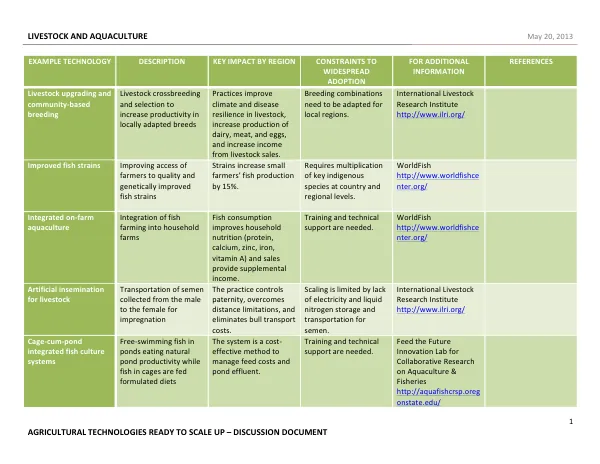
Livestock upgrading and community-based breeding programs have been implemented to increase productivity in locally adapted breeds.
2013 · 3 pages
Sign in to readA free account is required to download.
Abstract
Practices such as crossbreeding and selection improve climate and drought resilience in livestock, increase production of dairy, meat, and eggs, and enhance income from livestock sales. Breeding combinations need to be adapted for local regions. Improved fish farming has been implemented to improve access of farmers to high-quality and genetically improved fish strains. Strains such as tilapia and tilapia hybrids have been developed to increase small-scale farmers' fish production by 15%. Multiplication of key indigenous species at country and regional levels is required. WorldFish has developed and disseminated improved fish farming technologies to increase fish production and income for small-scale farmers. Integrated aquaculture systems have been implemented to improve household nutrition and income. Fish consumption improves household nutrition, and sales provide supplemental income. Training and technical support are needed to improve fish farming practices and increase income for small-scale farmers. Artificial insemination has been implemented to control paternity, overcome distance limitations, and eliminate bull transport costs. However, scaling is limited by lack of electricity and liquid nitrogen storage and transportation for semen. The International Livestock Research Institute has developed and disseminated artificial insemination technologies to improve livestock breeding and increase income for small-scale farmers. Cage-cum-pond fish culture systems have been implemented to improve fish production while reducing feed costs. The system is a cost-effective method to manage feed costs and improve fish production. Training and technical support are needed to improve fish farming practices and increase income for small-scale farmers. Seaweed polyculture has been implemented to increase income for shrimp farmers. Production of seaweed provides additional income for shrimp farmers. Post-harvest drying and processing increase incomes through the sale of high-quality algae for food and other value-added products. Training and technical support are needed to improve seaweed farming practices and increase income for small-scale farmers. Rice-fish culture has been implemented to improve rice production while reducing pests and diseases. The adoption of rice-fish culture can bring opportunities for farmers to diversify farming activities, improve diets and nutrition for farm households, increase income, reduce or eliminate the use of hazardous chemicals, and make efficient use of water. Training and technical support are needed to improve rice-fish culture practices and increase income for small-scale farmers. High-quality fodder has been implemented to improve animal health. Lack of availability of high-quality fodder has been a major constraint to improving animal health. The CGIAR has developed and disseminated high-quality fodder technologies to improve animal health and increase income for small-scale farmers. Vaccines have been developed to control Newcastle disease, Newcastle disease is a major constraint to small-scale poultry production in Africa, the Middle East, and Asia. The vaccine prevents infection in chickens and reduces mortality and economic losses to small-scale poultry farmers. However, establishing vaccine production and distribution to farmers in a cost-effective manner is a major challenge. Porcine cysticercosis vaccine has been developed to control tapeworms that infect pigs that eat human feces. Consuming undercooked, infected pork can result in cysticerci in multiple tissues, including the brain. The vaccine prevents infection in pigs and the resulting human health impacts. However, the vaccine distribution method is not determined. PPR (peste des petits ruminants) vaccine has been developed to control the PPR virus that infects primarily goats and sheep and is a major impediment to small ruminant production in Africa, the Middle East, and Asia. The vaccine prevents infection in small ruminants, reducing morbidity and mortality from infection. However, the vaccine distribution method is not determined.
Related documents