USAID
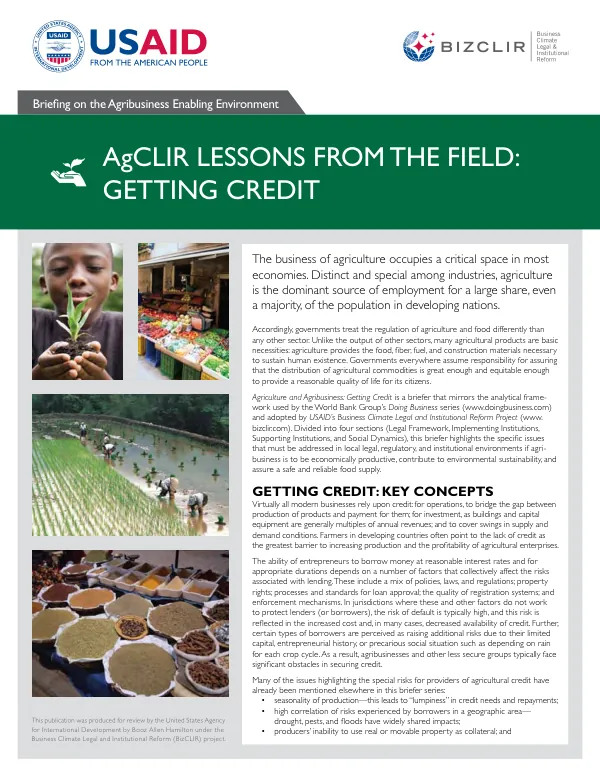
Agriculture and Agribusiness: Getting Credit
The agricultural sector plays a critical role in the economies of developing nations, providing employment for a large share of the population.
2011 · 4 pages
Sign in to readA free account is required to download.
Abstract
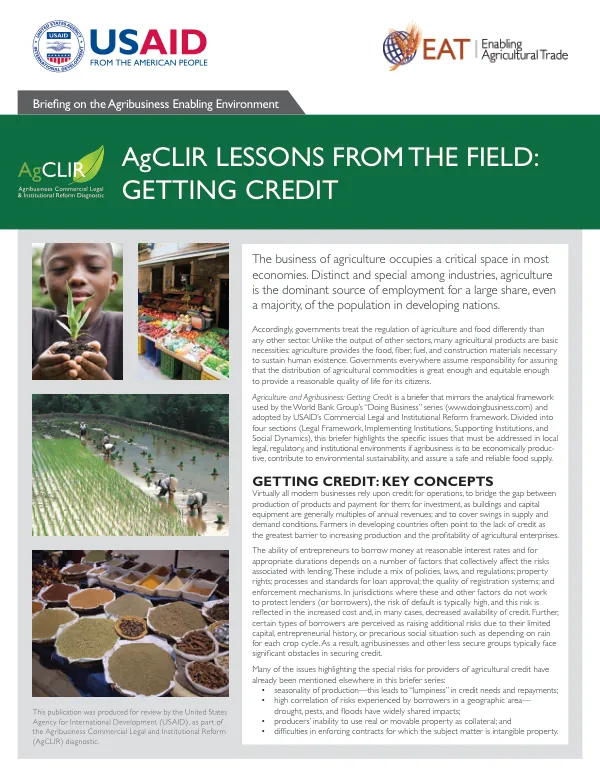
Governments assume responsibility for ensuring that agricultural commodities are distributed equitably to provide a reasonable quality of life for citizens. The regulation of agriculture and food is distinct from other sectors, as many agricultural products are basic necessities. Agriculture and agribusiness rely heavily on credit for operations, investment, and to cover swings in supply and demand conditions. However, farmers in developing countries often face significant barriers to accessing credit, including high interest rates, limited collateral options, and a lack of creditworthiness. The ability of entrepreneurs to borrow money at reasonable interest rates and for appropriate durations depends on a variety of factors, including policies, laws, and regulations, property rights, and enforcement mechanisms. The seasonality of production, high correlation of risks, and producers' inability to use real or movable property as collateral are among the issues that highlight the special risks for providers of agricultural credit. Lenders have been reluctant to seize agribusinesses' assets, even when legally allowed to do so, due to the potential for total impoverishment of the family. Agricultural production enterprises that are more diverse may seem better candidates for credit, but the complexity of diversified operations makes evaluation of their creditworthiness more difficult. Producers who join cooperatives gain a significant edge in accessing credit, as lenders' costs and risks are reduced. The possibility of expanding the microfinance model to an increasing array of agribusinesses, especially small and family-owned/-operated businesses, has been explored in some countries. Trade financing for agricultural products can be secured by contracts for sale or against inventory as collateral, requiring significant organization and formalization of markets. The legal framework for getting credit or accessing financial services is comprised of a variety of laws, including real property law and secured transactions law. These laws enable lenders to reduce costs and manage their risks more effectively, helping potential borrowers gain access to beneficial financial services. Collateral lending lowers the risk of non-payment, as the borrower will normally pay off the loan instead of losing the property used as collateral. Well-structured collateral lending systems also expand the scope of property that can be used as collateral, and thus expand access to credit. In many countries, agribusinesses are unable to claim ownership to real property, limiting their ability to borrow on the basis of collateral in the formal banking sector. This accounts for the popularity of alternative credit sources, such as input dealers and agricultural processing companies, which provide supplier credit to producers. Contract law is an essential underpinning for such credit, as the ownership of intangible property serves as security for agricultural credit.