BOOZ, ALLEN AND HAMILTON, INC.
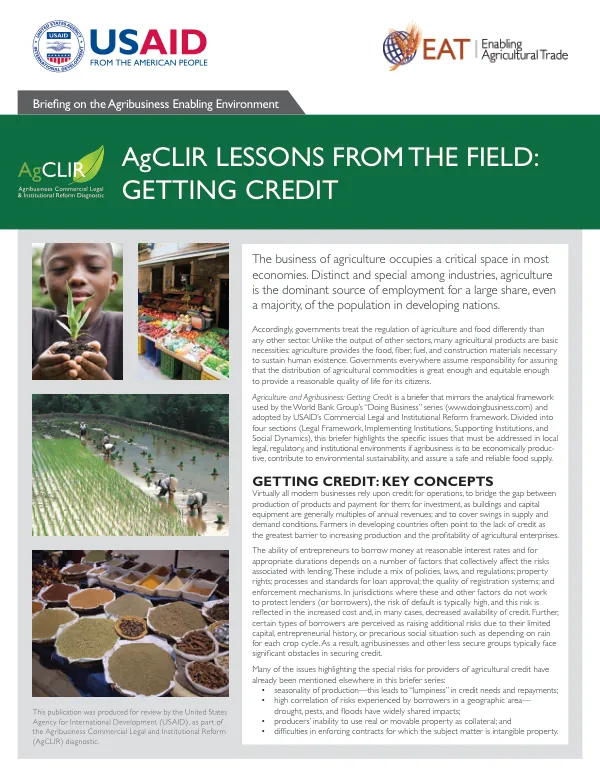
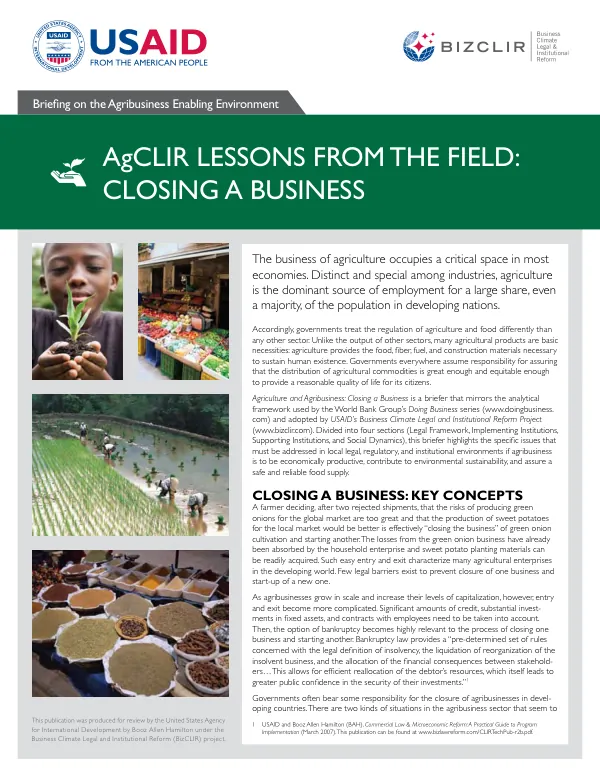
Agriculture and Agribusiness: Getting Credit
The agricultural sector plays a critical role in most economies, particularly in developing nations where it is the dominant source of employment for a large share of the population.
2009 · 4 pages
Sign in to readA free account is required to download.
Abstract
Governments treat the regulation of agriculture and food differently than other sectors due to the essential nature of agricultural products, which include basic necessities such as food, fiber, fuel, and construction materials. Governments assume responsibility for ensuring that the distribution of agricultural commodities is sufficient and equitable to provide a reasonable quality of life for citizens. Agriculture and agribusiness rely heavily on credit for operations, investment, and to cover swings in supply and demand conditions. However, farmers in developing countries often point to the lack of credit as the greatest barrier to increasing production and the profitability of agricultural enterprises. The ability of entrepreneurs to borrow money at reasonable interest rates and for appropriate durations depends on various factors, including policies, laws, and regulations, property rights, loan approval processes, registration systems, and enforcement mechanisms. The seasonality of production, high correlation of risks among borrowers, and producers' inability to use real or movable property as collateral are among the issues that highlight the special risks for providers of agricultural credit. Many enterprises are family operations, which raises social issues not encountered in lending to other small or medium-scale enterprises. Lenders have been reluctant to seize agribusinesses' assets, even when legally allowed to do so, due to the risk of total impoverishment. Producers who join cooperatives gain a significant edge in accessing credit, as lenders' costs and risks are reduced. The possibility of expanding the microfinance model to an increasing array of agribusinesses, especially small and family-owned/operated businesses, has been explored in some countries. However, microfinance institutions are cautious about explicitly expanding their business in the agricultural sector due to the seasonality of borrowing and payback, as well as the high level of correlated risk among borrowers. Trade financing for agricultural products can be secured by contracts for sale or against inventory as collateral, requiring significant organization and formalization of markets. Agribusinesses that engage in international trade are generally forced to seek trade financing to manage cash flow between the time of shipping and payment. Agribusinesses that deal in the import and distribution of production inputs and process raw agricultural materials into value-added products face credit conditions similar to those of other processing or manufacturing industries. The legal framework for getting credit or accessing financial services is comprised of various laws that enable lenders to reduce costs and manage their risks more effectively. A real property law and a secured transactions law provide the basic legal framework for agribusinesses registered under the company law to access bank credit and for lenders to seek recourse in the event of an agribusiness' default. Collateral lending lowers the risk of non-payment by allowing the lender to seize and liquidate assets if the borrower defaults. Well-structured collateral lending systems also expand the scope of property that can be used as collateral, and thus expand access to credit.
Related documents