USAID DEC
Technical and Operational Performance Support (TOPS) Program and Food Security and Nutrition (FSN) Network Resource Repository
Sign inCENTER FOR INTERNATIONAL FORESTRY AND RESEARCH
Technical and Operational Performance Support (TOPS) Program and Food Security and Nutrition (FSN) Network Resource Repository
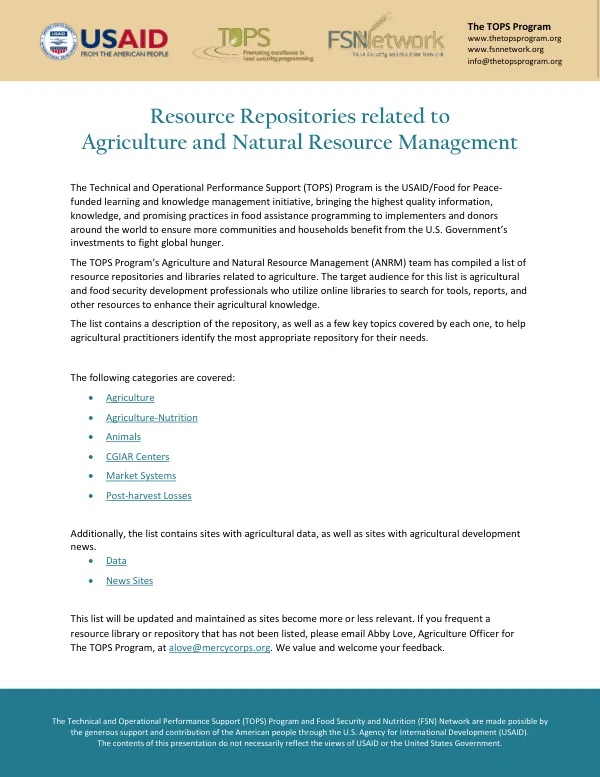
The Technical and Operational Performance Support (TOPS) Program is a learning and knowledge management initiative funded by USAID's Food for Peace program.
2016 · 6 pages
Sign in to readA free account is required to download.
Abstract
The program aims to bring high-quality information, knowledge, and promising practices in food assistance programming to implementers and donors worldwide. This enables more communities and households to benefit from the U.S. Government's investments to fight global hunger. The TOPS Program's Agriculture and Natural Resource Management (ANRM) team has compiled a list of resource repositories and libraries related to agriculture. The list targets agricultural and food security development professionals who utilize online libraries to search for tools, reports, and other resources to enhance their agricultural knowledge. The repositories are categorized into several areas, including agriculture, agriculture-nutrition, animals, CGIAR centers, market systems, post-harvest losses, data, and news sites. Agrilinks is a Feed the Future-funded knowledge sharing website that contains a growing collection of resources, screencasts, and tools related to agriculture-led food security. The topics covered include extension, nutrition, gender, natural resource management, capacity building, technology, and more. The Food Security and Nutrition Network (FSN Network) Resource Library features practical implementation-focused guides, tools, and training materials, extending beyond agriculture to include nutrition, gender, resilience, and more. The FAO Animal Production and Health Division (AGA) strives to assist Member countries to take full advantage of the contribution the rapidly growing and transforming livestock sector can make towards achievement of the Millennium Development Goals (MDGs). The topics covered include animal production, animal health, feed safety, and more. The FAO Pastoralism Knowledge hub is an initiative bringing together pastoralists and the main actors working with them to join forces and create synergies for dialogue and pastoralist development. The CGIAR Centers are independent, non-profit research organizations innovating on behalf of poor people in developing countries. The 15 CGIAR centers cover a range of topics, including crop production, climate change, agroforestry, farm system resilience, and more. Bioversity International delivers scientific evidence, management practices, and policy options to use and safeguard agricultural and tree biodiversity to attain sustainable global food and nutrition security. The topics covered include agricultural biodiversity, climate change adaptation, agroforestry, and more. The International Center for Agricultural Research (ICARDA) promotes agricultural development in the dry areas of developing countries through research and training activities. The topics covered include climate change adaptation, improving nutrition, women's empowerment, and more. The International Center for Tropical Agriculture (CIAT) is a not-for-profit research and development organization dedicated to reducing poverty and hunger while protecting natural resources in developing countries. The topics covered include enhanced agricultural production, improved nutrition in tropical settings, and more. The International Crops Research Institute for the Semi-Arid Tropics (ICRISAT) is a non-profit, non-political organization that conducts agricultural research for development in the drylands of Asia and sub-Saharan Africa. The topics covered include crop improvement, aflatoxin, postharvest management, seeds systems, and more. The International Food Policy Research Institute (IFPRI) provides research-based policy solutions to sustainably reduce poverty and end hunger and malnutrition in developing countries. The topics covered include sustainable food production, nutrition, markets, rural growth, resilience, and more. The International Institute of Tropical Agriculture (IIAT) addresses the needs of the poor and vulnerable in the tropics through agricultural research for development. IIAT works with public and private sector partners to enhance crop quality and productivity, reduce risk to producers and consumers, and generate scientific evidence to inform policy and decision-making.
Related documents