USAID. MISSION TO SRI LANKA
Agriculture planning and analysis project
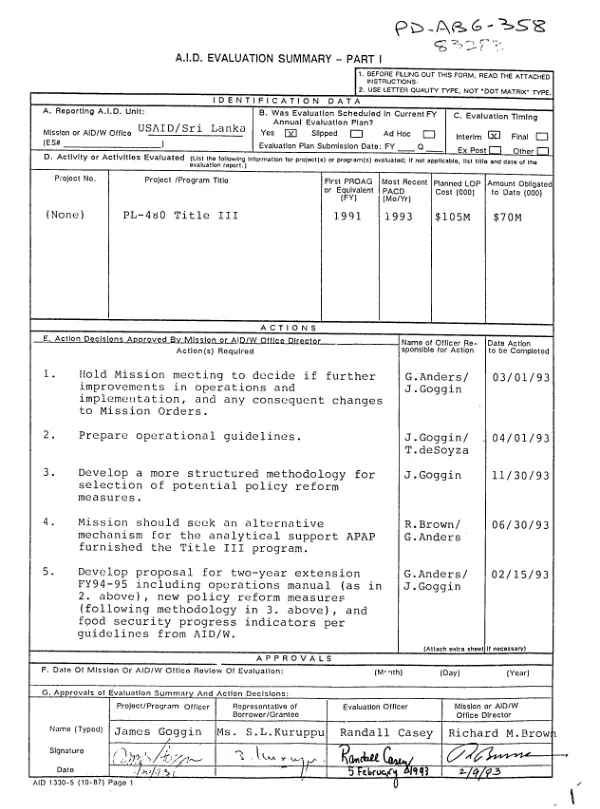
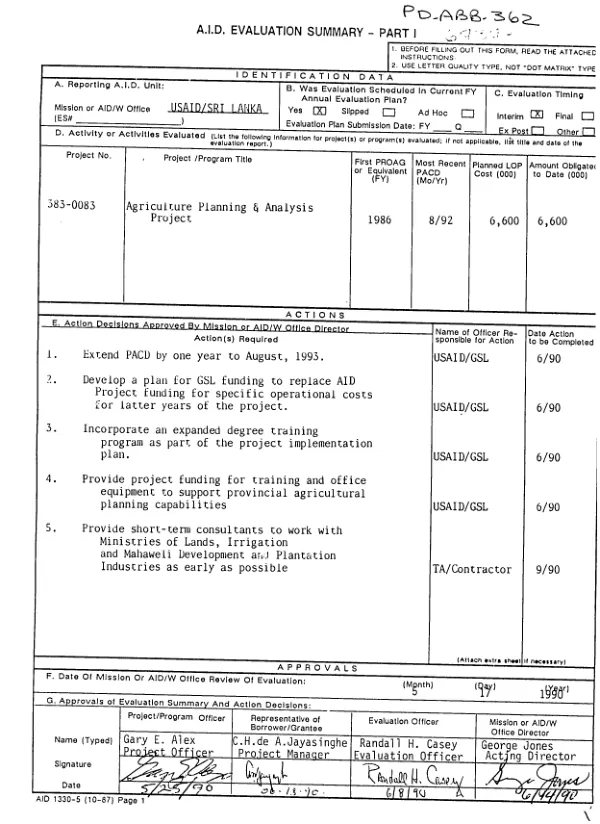
Summarizes mid-term evaluation (unattached) of a project to develop an integrated, national-level agricultural planning system in Sri Lanka.
1990
Sign in to readA free account is required to download.
Abstract
The evaluation covered the period 8/86- 4/90. Project implementation has been delayed, partly due to a project design which combined a host country contract with a planned late arrival of technical advisors, and partly due to governmental reorganization and security problems. As a result, both A.I.D. and Government of Sri Lanka expenditures have been far below the expected level. However, the recent arrival of a skilled long- term policy advisor who has previous experience in Sri Lanka and has excellent rapport with host government officials has raised project activities to a higher level. This event combined with the beginning flow of returning trained planning unit staff and the enthusiasm of key Sri Lankan planners and administrators has significantly improved project performance. Progress has been uneven among the five participating ministries. The Ministry of Lands, Irrigation, and Mahaweli Development and the Ministry of Plantation Industries have lagged far behind the others in terms of training and policy research. A major reason for these shortcomings is the lower use/availability of project inputs, including TA, training, and operational funds. Provision of specialized, short-term assistance to the two ministries would help overcome present implementation problems. Since recent governmental reorganization has shifted the focus of some agricultural planning from the national to provincial organizations, it is recommended that the latter be included in the project"s target audience. Two major lessons were learned. (1) Agricultural planning and policy activities are by nature integrative and long term in maturing. Project design should take this into account and allow realistic time frames for effecting positive results. (2) The combination in the project design of a host country contract and delayed TA should be avoided, since it virtually assures unwarranted complexity and implementation delay.
Related documents