USAID. MISSION TO SRI LANKA
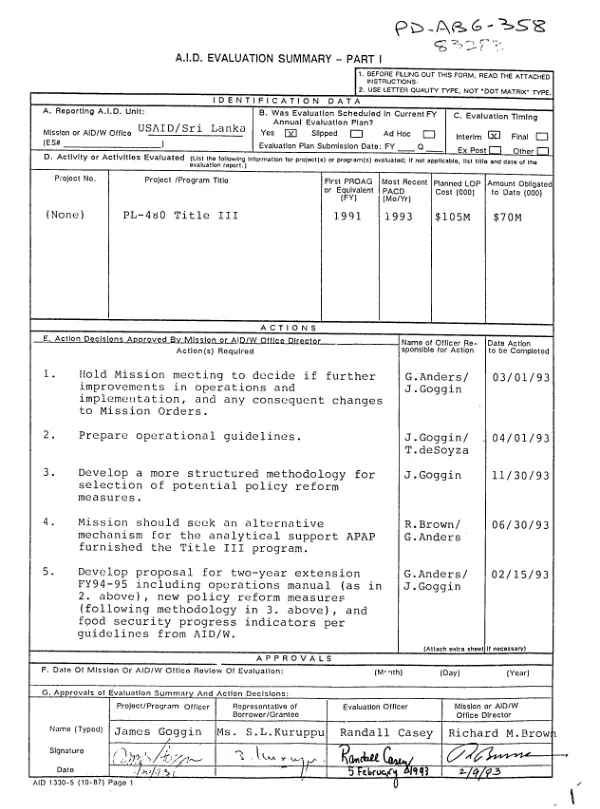
PL-480 Title III
Summarizes mid-term evaluation (PD-ABF-670) of a P.L.
1993
Sign in to readA free account is required to download.
Abstract
480 Title III food aid program tied to policy reforms in Sri Lanka"s agricultural sector. The evaluation covered the period 1991-10/92. The program as a whole is going extremely well, and has several accomplishments in its first 15 months. The policy reforms being pursued are consistent with USAID"s strategic objectives -- reducing the role of the government, strengthening the private sector, and increasing market responsiveness -- and have produced fiscal and economic benefits by reducing losses due to inefficient government operations, and increasing output, employment, and incomes. Moreover, the groundwork is being laid for even more substantial reforms in the future. USAID"s concentration on important specific measures and tight programming of reforms and benchmarks is correct, and also complements the broad reforms included in the programs of other international agencies. The success of the policy program can largely be attributed to the use of a performance-based disbursement system, which has created positive incentives for the Government of Sri Lanka (GSL) to expedite implementation of reforms. The program"s success also reflects sound policy development on the part of USAID/SL, the Mission"s extensive experience with its prior Title I program, and its willingness to look at itself and accept constructive criticism. The movement of P.L. 480 commodities within Sri Lanka has been reasonably efficient (partly due to intensive Mission monitoring -- the GSL institutions involved in the grain trade have a history of permitting deterioration of foods and of excessive costs due to overstaffing). On the U.S. side, however, there have been problems with late shipments, and in some cases, shipments of substandard grain. Reporting, monitoring, and follow-up systems are adequate and prompt; both the GSL and USAID/SL have performed well in creating and operating the systems. The price negotiation procedure for commodities has been efficient and reflective of market prices; however, the process for choosing recipient agencies and allocating commodities is too informal and lacks proper documentation. Local currency generations from commodity sales are being used for activities consistent with the enabling P.L. 480 legislation and USAID policy; the food stamp program is the most important single element of food security for lower-income Sri Lankans. Given the scope of issues which the Mission is addressing, a 2-year extension of the program is requested by USAID/SL to ensure completion of the reform process. The evaluation suggests that the impact of reforms can be further improved by instituting a more rigorous process of selecting and formulating reforms and benchmarks.
Related documents