USAID DEC
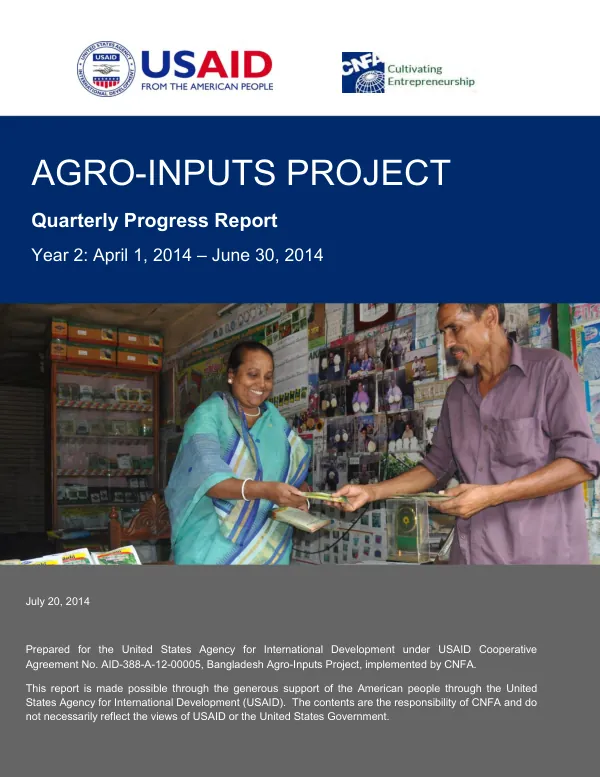
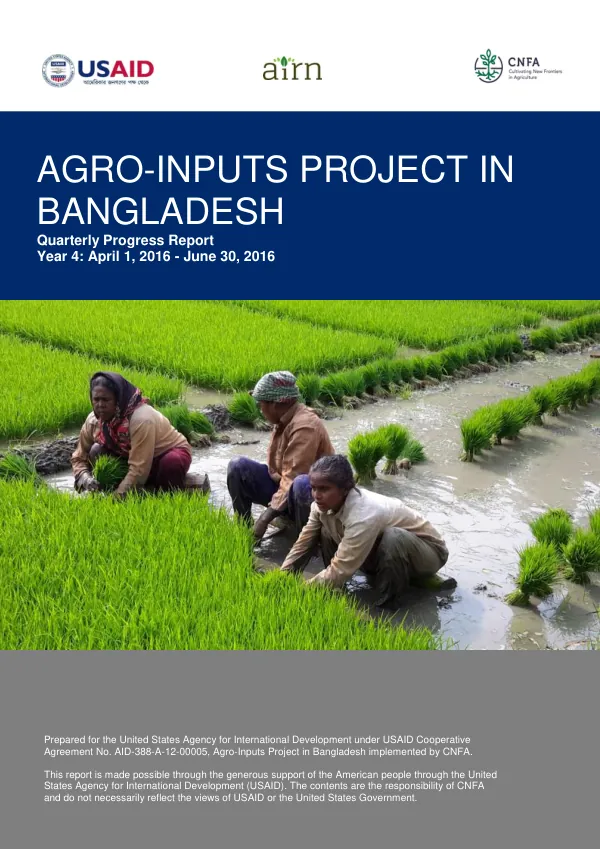
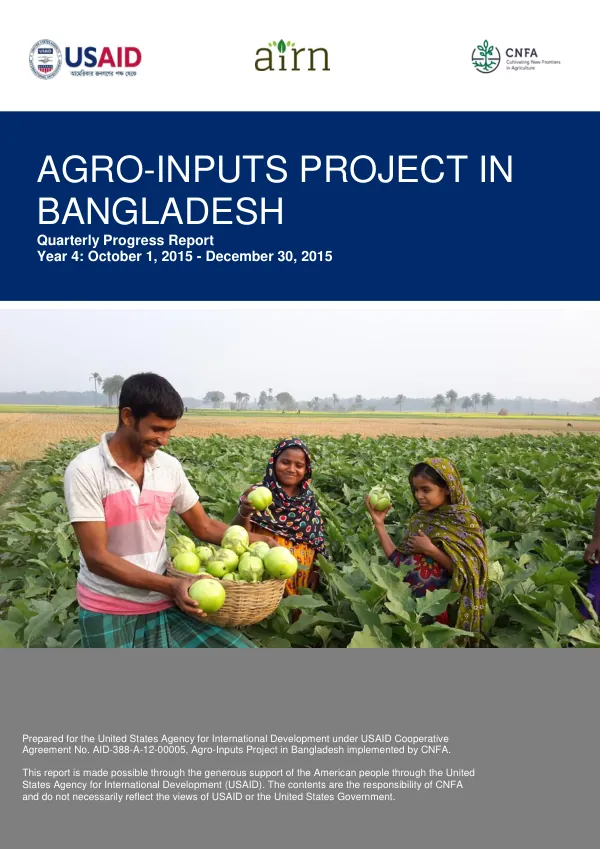
Agro-Inputs Project in Bangladesh: Quarterly Progress Report - Quarter 2, Year 2: January 1, 2014 – March 31, 2014
Sign inCNFA, INC.
Agro-Inputs Project in Bangladesh: Quarterly Progress Report - Quarter 2, Year 2: January 1, 2014 – March 31, 2014
The Agro-Inputs Project in Bangladesh is a five-year initiative aimed at improving the supply of quality agricultural inputs through input retailers.
2014 · 51 pages
Sign in to readA free account is required to download.
Abstract
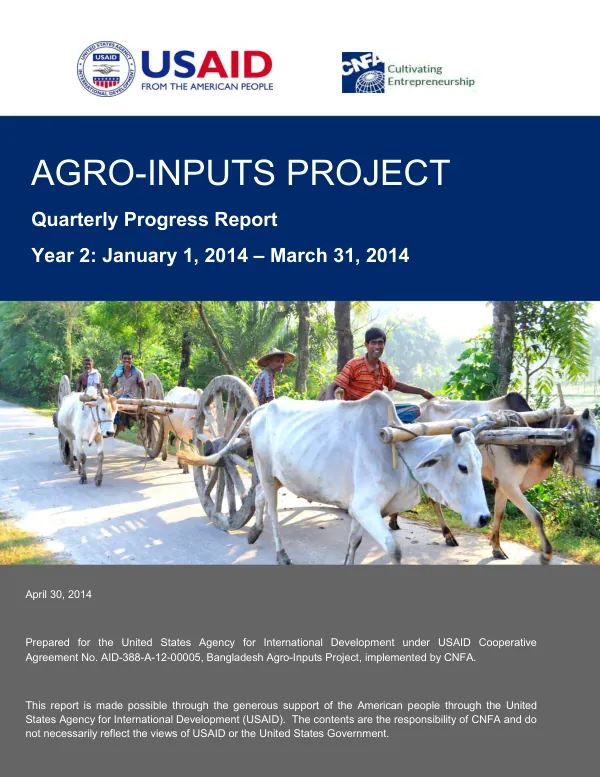
The project, implemented by CNFA, began on September 17, 2012, and is funded by the United States Agency for International Development (USAID) under Cooperative Agreement No. AID-388-A-12-00005. The project has a total award amount of $14,028,602. The project's objective is to create a sustainable Agro Input Retailers Network (AIRN) through Intervention 1, which involves establishing a network of 3,000 Government of Bangladesh (GOB)-registered retailers to supply quality, unadulterated agricultural inputs to over 1 million farmers. Among the 3,000 retailers, 300 will be women-owned and will be established by matching grants and other technical assistance. The project's four interventions are designed to work in concert and holistically with Intervention 1. These interventions include the development of Market Information Systems, setting Quality Control Standards for inputs and lessening Regulatory Constraints, and strengthening Local Organizations towards direct implementation. In the second quarter of Year 2 (January 1 through March 31, 2014), AIP made strong advances in all four of its interventions and in its environmental compliance, communications, and gender-related activities. Highlights of the quarter include the organization of AIRN membership drive events in 12 new upazillas, resulting in 193 additional retailers joining as Associate members. Total membership reached 309 retailers by the end of the quarter. Three input supply companies delivered basic training to 618 retailers in Quarter 2, qualifying them to become Accredited AIRN members. The AIRN Supply Chain Advisor (ASCA) was hired in the quarter and began work in the first week of Q3. AIP's Pesticide Evaluation Report and Safer Use Action Plan (PERSUAP) was approved by USAID's Environmental Office in Washington in mid-January, and AIP coordinated with Syngenta, Bayer CropScience, and Lal Teer to finalize detailed plans to establish the first 170 demonstration plots. AIP also began environmental evaluations of the proposed plots' locations and delivered several trainings in the quarter, including CFR 216 and its relevance to due diligence of sub-recipients to AIP, training of AIP staff on actionable responsibilities ensuing from the combined EDDR and PERSUAP, and a "shop-level" training curriculum to train AIRN member retailers on safe use and handling of pesticides in their shops. In addition, AIP signed a service contract with GMark Consulting Ltd. in mid-January to conduct 40 batches of retailer trainings to a total of 1,000 AIRN Associate members by the end of the quarter. The project's field team made strong accomplishments, particularly in the AIRN membership drives, and Demonstration Plot collaborators were able to confidently plan at quarter's end, with AIP, demonstrations of quality agro-inputs and associated Field Days. The project's progress in the second quarter of Year 2 demonstrates its commitment to improving the supply of quality agricultural inputs and promoting sustainable agricultural practices in Bangladesh.