CNFA, INC.
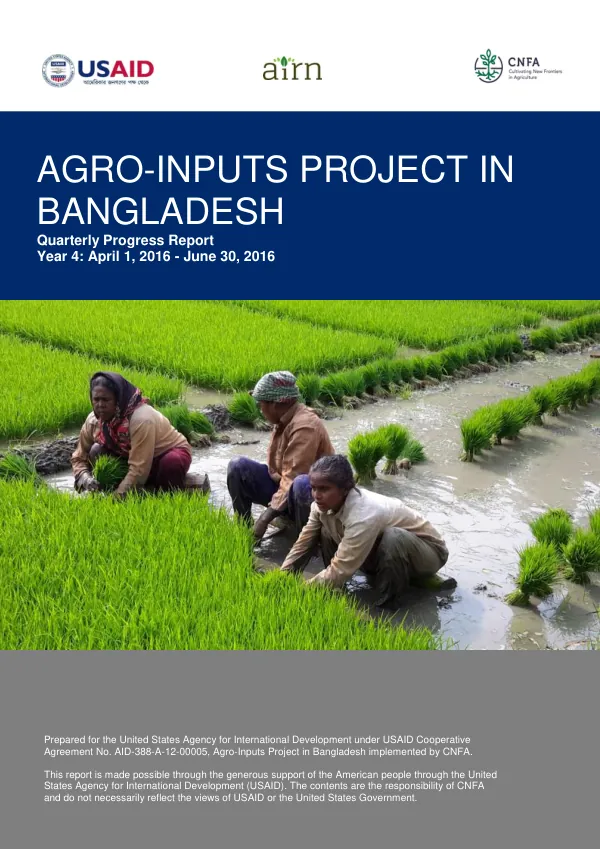
Quarterly Progress Report Y4Q3: Agro-Inputs Project in Bangladesh
The Agro-Inputs Project in Bangladesh is a five-year initiative implemented by CNFA, with a total award amount of $14,028,602, under the Cooperative Agreement No.
2016 · 31 pages
Sign in to readA free account is required to download.
Abstract
AID-388-A-12-00005 with the United States Agency for International Development (USAID). The project aims to improve the supply of quality agricultural inputs through input retailers, with a focus on creating a sustainable Agro Input Retailers Network (AIRN). The project's central effort is the creation of AIRN, a first-of-its-kind agro-inputs training organization serving retailers in the Feed the Future (FTF) zone. AIRN has achieved its life of project goal of recruiting 3,000 retailers, with a total of 3,132 members, 126 of whom are female. AIP engages AIRN members in basic training to transfer key technical skills, making them fully accredited. Interventions 2-4 are designed to work in concert with Intervention 1. Intervention 2 aims to improve the effectiveness of agricultural inputs market information systems, with the distribution of 115,000 hard copy Monthly Price Outlook Bulletins (MPOB), supported by an innovative Geographic Information System (GIS)-based input market information system (MIS). Demand creation for improved quality inputs is also promoted through 500 demonstration plots. Intervention 3 focuses on enhancing knowledge and application of quality standards, with the promotion of input quality standards to 50 input supply companies and 3,000 AIRN retailers. Eight new input quality standards developed by industry associations, with public and private stakeholders, have been presented to USAID for referral to the Bangladesh Policy Research and Strategy Support Program (BPRSSP). Knowledge and demand for quality inputs are increased through communications and outreach campaigns. Intervention 4 aims to strengthen local organizations' institutional capacity, with three organizations receiving comprehensive organizational capacity assessment (OCA) and necessary assistance in organizational capacity development (OCD). Organizational strengthening of these organizations and utilization of their technical expertise to implement AIP-related activities via sub-award are also key objectives. The project has made significant progress in achieving its objectives, with a total of 3,132 AIRN members, 126 of whom are female, and the distribution of 115,000 hard copy MPOB. The project has also promoted input quality standards to 50 input supply companies and 3,000 AIRN retailers, and has increased knowledge and demand for quality inputs through communications and outreach campaigns. In terms of geographic focus, the project is implemented in the Feed the Future (FTF) zone in Bangladesh. The project's timeframes are from September 17, 2012, to September 16, 2017, with a quarterly reporting cycle. The project's recommendations include the continued support for the development of AIRN, the expansion of the GIS-based input market information system, and the strengthening of local organizations' institutional capacity. The project has also identified several success stories, including the establishment of a sustainable Agro Input Retailers Network (AIRN), the distribution of 115,000 hard copy Monthly Price Outlook Bulletins (MPOB), and the promotion of input quality standards to 50 input supply companies and 3,000 AIRN retailers. These success stories demonstrate the project's impact on improving the supply of quality agricultural inputs in Bangladesh.
Related documents