CNFA, INC.
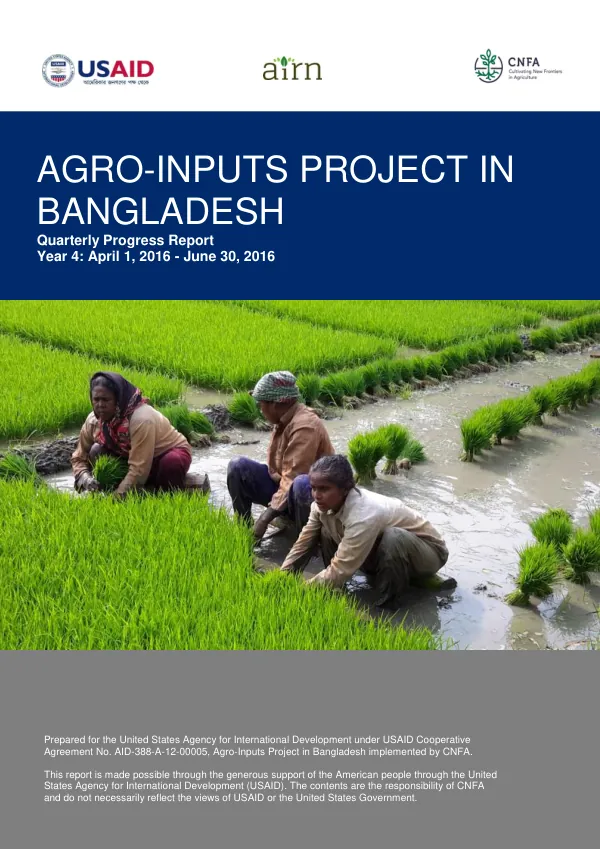
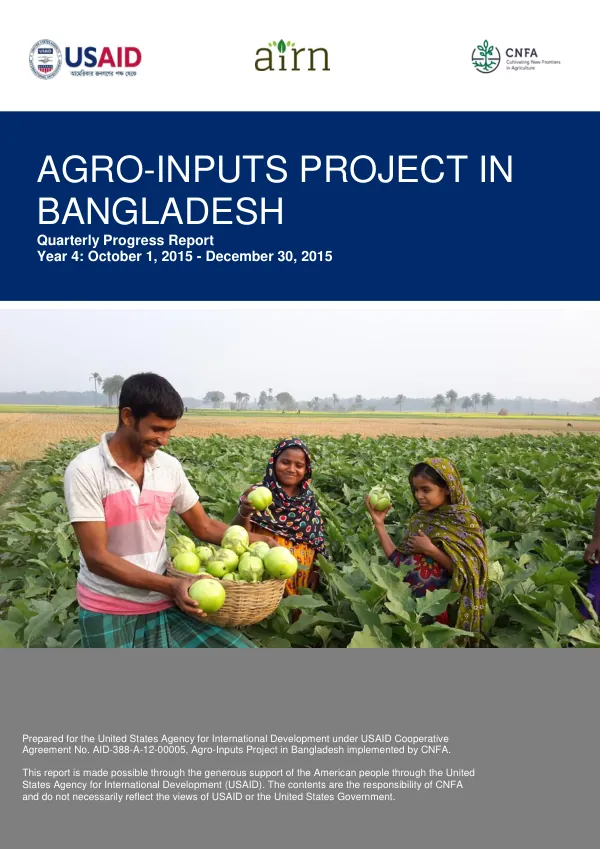
Quarterly Progress Report Y4Q1: Agro-Inputs Project in Bangladesh
The Agro-Inputs Project in Bangladesh is a five-year initiative implemented by CNFA, with a start date of September 17, 2012, and an award amount of $14,028,602.
2016 · 32 pages
Sign in to readA free account is required to download.
Abstract
The project's central objective is to improve the supply of quality agricultural inputs through input retailers. To achieve this goal, the project has four interventions: Establish an Agro-Inputs Retailers Network, Improve Effectiveness of Agricultural Inputs Market Information Systems, Enhance Knowledge and Application of Quality Standards, and Strengthen Local Organizations' Institutional Capacity. The first intervention, Establish an Agro-Inputs Retailers Network, aims to create a sustainable Agro Input Retailers Network (AIRN) through the development of a high-quality technical training and advisory services center. This center will provide training and services to agro-input dealers in the Feed the Future (FTF) zone. The project has also developed a governance structure, membership strategy, and training and services plan for AIRN. As of the end of the first quarter of year 4, the project has promoted AIRN among agro-input dealers in the FTF zone. The second intervention, Improve Effectiveness of Agricultural Inputs Market Information Systems, focuses on improving the distribution of market information to agro-input dealers. The project has developed a Geographic Information System (GIS)-based input market information system (MIS) to provide accurate and timely market information. Additionally, the project has distributed 115,000 hard copy Monthly Price Outlook Bulletins (MPOB) to agro-input dealers. The project aims to increase awareness and demand for quality inputs through 500 demonstration plots. The third intervention, Enhance Knowledge and Application of Quality Standards, aims to promote input quality standards to 50 input supply companies and 3,000 AIRN retailers. The project has developed eight new input quality standards in collaboration with industry associations and public and private stakeholders. The project also conducts communications and outreach campaigns to increase knowledge and demand for quality inputs. The fourth intervention, Strengthen Local Organizations' Institutional Capacity, focuses on strengthening the institutional capacity of three local organizations. The project conducts comprehensive organizational capacity assessments (OCA) and provides necessary assistance in organizational capacity development (OCD) to these organizations. The project aims to utilize the strengthened capacity of these organizations to improve the supply of quality agricultural inputs. As of the end of the first quarter of year 4, the project has made significant progress in all four interventions. The project has promoted AIRN among agro-input dealers, distributed market information to agro-input dealers, promoted input quality standards, and strengthened the institutional capacity of local organizations. The project's success is evident in the increased adoption of quality inputs by agro-input dealers and the improved supply of quality agricultural inputs in the FTF zone.
Related documents