USAID DEC
AID cooperative agreement no. OTR-0158-A-00-0087-00 with the Pan American Development Foundation (PADF) to combine a two - pronged approach to include implementation by farmers of environmentally sound agroforestry practices (soil enhancement, erosion controls, tree/crop rotation) with NGO strengthening in six countries of the Caribbean Basin
Sign inUSAID. BUR. FOR FOOD FOR PEACE AND VOLUNTARY ASSISTANCE. OFC. OF PRIVATE AND VOLUNTARY COOPERATION (PVC)
AID cooperative agreement no. OTR-0158-A-00-0087-00 with the Pan American Development Foundation (PADF) to combine a two - pronged approach to include implementation by farmers of environmentally sound agroforestry practices (soil enhancement, erosion controls, tree/crop rotation) with NGO strengthening in six countries of the Caribbean Basin
Grant is provided under the Matching Grants to PVOs to the Pan American Development Foundation (PADF) to help local NGOs in six Caribbean Basin countries (Costa Rica, the Dominican Republic.
1990
Sign in to readA free account is required to download.
Abstract
Antigua, Dominica, St. Kitts. and St. Lucia) to implement agroforestry projects. In all six countries, PADF will train local technical staff, develop service delivery networks under the leadership of local NGOs, educate farm populations about the economic benefits of trees and other soil improvements, and conduct analyses of the economic benefits of agroforestry. More specifically, in Costa Rica, PADF will (1) adapt its farmer-based agroforestry outreach systems developed in Haiti to promote hillside management of 713 acres through plantings of perennials and woodlots, and (2) institutionalize practices to improve and diversify food production on 750 acres. Farmers and community organizations will be trained in nursery construction and management, seed collection, direct seeding, grafting, and living terrace and hedgerow establishment. Grassroots NGOs will be trained to manage income deriving from the project. The Asociacion Desarrollo del Pequeno Empresario (ADEPE) will receive forestry and agronomic training. In the Dominican Republic, PADF will institutionalize improved agroforestry practices in the highlands of the southwestern coast. Activities will focus on using fast-growing trees suitable for construction, fence posts, charcoal, living fences, etc., as well as on plants suitable as erosion barriers. Terracing and water channeling practices will be incorporated into reforestation. Significant investments in nurseries are not envisioned. In Antigua, PADF will (1) train staff in practices to benefit farmer incomes and provide import substitutes for fruits and vegetables, especially organically grown produce; (2) improve farmer organizations" and NGOs" agroforestry outreach, marketing, and management skills; and (3) create a demonstration farm and an environmental education initiative focusing on the economic benefits of restoring degraded ecosystems. PADF will also: help the Cooperative Farmers Association create a site for observing sound agroecological farming; conduct trials of tree-crop associations; and provide NGO planning and management support. In Dominica, PADF will (1) train extensionists and farmers; (2) expand nursery production of new border and intercrop tree species; and (3) conduct new demonstrations of trees in combined planting arrangements. The primary focus will be expansion of practices which benefit cocoa, a major export crop, to other crops, with particular emphasis on shelter by other trees. Other activities will include support for the Ministry of Agriculture"s extensionist training and support for NGOs in planning and management. In St. Kitts, PADF will expand government and Organization of American States agroforestry activities in the private sector. Small farmers will be helped to restore cultivation and introduce mixed vegetable and fruit production. PADF will be working with the St. Kitts Farmers" Cooperative and possibly the Peace Corps. In St. Lucia, the program will expand agroforestry technology which has been adapted for fine-flavor cocoa production to other crops. This effort will support the government"s goal of helping farmers meet demand for food and fruit crops and for trees needed for construction.
Related documents
Documents in this collection
 1986
1986USAID DEC
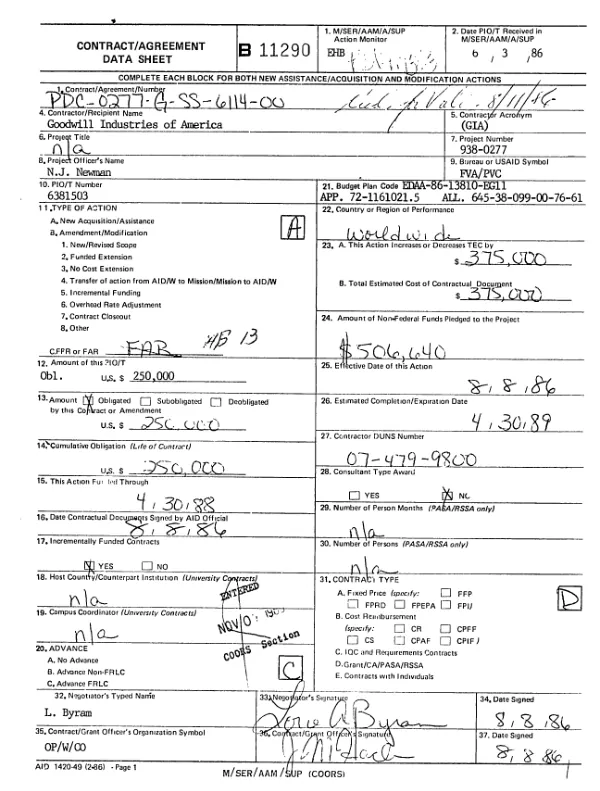
Grant no. PDC-0277-G-SS-6114-00 to Goodwill Industries of America, Inc.
Open record 1979
1979USAID DEC