USAID DEC
AID cooperative agreement no. OTR-0500-A-00-0099-00 with People to People Health Foundation Inc. to support child survival/Vitamin A projects in Indonesia, Malawi, and Guatemala
Sign inUSAID. BUR. FOR FOOD FOR PEACE AND VOLUNTARY ASSISTANCE. OFC. OF PRIVATE AND VOLUNTARY COOPERATION (PVC)
AID cooperative agreement no. OTR-0500-A-00-0099-00 with People to People Health Foundation Inc. to support child survival/Vitamin A projects in Indonesia, Malawi, and Guatemala
Grant is provided under the Technical Support/Child Survival project (9380500) to Project HOPE to conduct child survival (CS) and Vitamin A programs in Indonesia, Malawi, and Guatemala.
1990
Sign in to readA free account is required to download.
Abstract
In Indonesia, Project HOPE will help the Center for Child Survival (CCS) of the University of Indonesia in Jakarta to train health professionals from the CCS, the School of Public Health/South Sulawesi, and the Ministry of Health through a series of workshops which will address management information systems, CS program management, learning resource development and social marketing, and the exchange of lessons learned among the staff of public and private sector CS projects. In the Thyolo district of Malawi, Project HOPE will undertake a 1-year pilot project. In the first phase, HOPE will gather baseline information on the target population of 4,000 children and their families -- about half of whom live in private estate compounds, and about half of whom live in villages in the Traditional Authority of Nchilamwela. Project HOPE officials will elicit the active cooperation of estate managers. In the second phase, HOPE will develop educational materials, provide training, and initiate service delivery of two high priority child survival strategies; oral rehydration therapy, malaria control, and child spacing education are the most likely interventions. The Project HOPE CS trainer will develop the curriculum for the selected strategies and train 4 health surveillance assistants, who will in turn train and supervise the 40 village health volunteers and estate health workers who will implement the CS activities. In Guatemala, Project HOPE will work with the Ministry of Health (MOH) and the Nutrition Institute for Central America and Panama to expand Vitamin A activities of its CS-IV program to all of San Marcos and Quetzaltenango, to serve an additional 160,000 children and 68,750 pre- and post-natal women. The 3-phase project will include a needs assessment, short-term interventions (i.e., immediate Vitamin A supplementation), and long-term interventions (i.e., nutritional education and seed packet distribution).
Related documents
Documents in this collection
 1991
1991USAID DEC
AID cooperative agreement no. PDC-0284-A-00-1123-00 with the International Eye Foundation (IEF) to support a Vitamin A and child survival project in the Lower Shire Valley of Malawi
Open record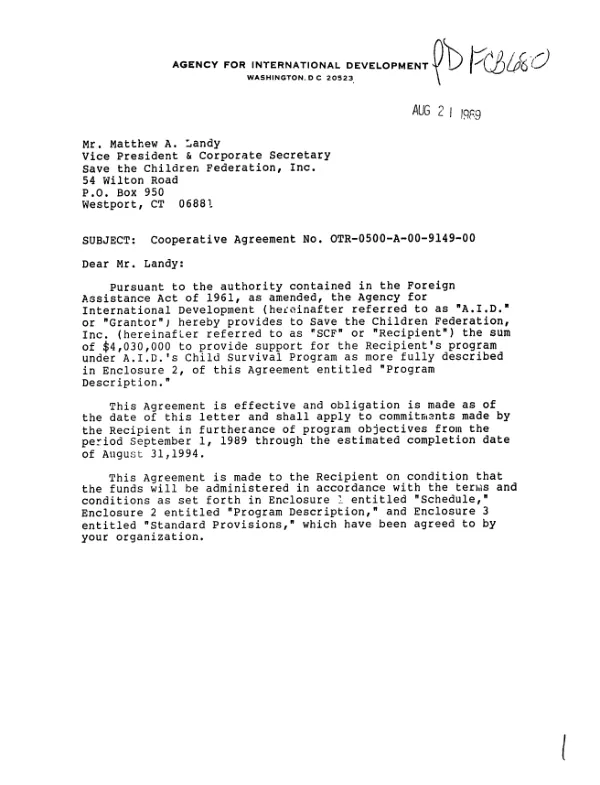 1989
1989USAID DEC