USAID DEC
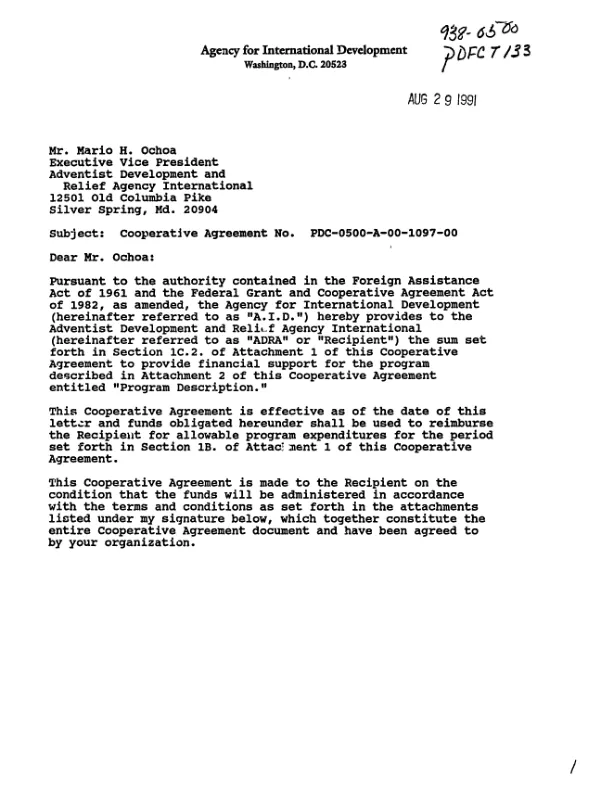
AID cooperative agreement no. PDC-0500-A-00-1097-00 with Adventist Development and Relief Agency International to support child survival projects in Nicaragua, Uganda, and Indonesia
Sign inUSAID DEC
AID cooperative agreement no. PDC-0500-A-00-1097-00 with Adventist Development and Relief Agency International to support child survival projects in Nicaragua, Uganda, and Indonesia
Grant is provided under the Technical Support/Child Survival Project (9380500) to Adventist Development and Relief Agency International (ADRA) for community-based child survival activities in Nicaragua, Uganda, and Indonesia.
1991
Sign in to readA free account is required to download.
Abstract
In Nicaragua, ADRA will support child survival activities in 200 communities in Region I -- a reduction, due to budget constraints, from the 342 communities in which ADRA has been working. The project will concentrate on growth monitoring and nutrition, oral rehydration therapy (especially home-based), and control of acute respiratory infections. Immunization activities will be limited to promotion and the provision to the Ministry of Health (MINSA) of the names of immunization defaulters. Maternal health activities will be restricted to promotion of prenatal care by community education and referrals to MINSA. Since barrier methods of contraception are often poorly accepted in Latin America, ADRA will concentrate on referrals to Profamilia. Other activities will include the retraining of 600 community volunteer health workers. In Uganda, ADRA will work in Kalagala and Zirobwe sub-counties in Wabusaana County in the southeast of Luwero District, an area devastated during the recent conflicts. include ORT, growth monitoring, promotion of kitchen gardens, immunizations of infants and women of child-bearing age, and family planning promotion. ADRA will seek to sustain the program through cost recovery and agriculturally based income-generating activities. In Indonesia, ADRA will begin new activities in Minahasa District, the site of a prior CS program which focused on the role of traditional birth attendants (TBA"s). All 38 government Puskesmas centers will be involved, compared to 17 previously, and ADRA will also add the Sangihe Talaud District to the program. Five interventions are planned: prenatal care, immunization, maternal/child nutrition, family planning, and (through alternate funding) complementary water, sanitation, hygiene activities.
Related documents
Documents in this collection
 1990
1990USAID DEC
AID cooperative agreement no. OTR-0500-A-00-0075-00 with the Cooperative for American Relief Everywhere to provide support for child survival projects in Mali and Honduras
Open record 1993
1993USAID DEC