USAID DEC
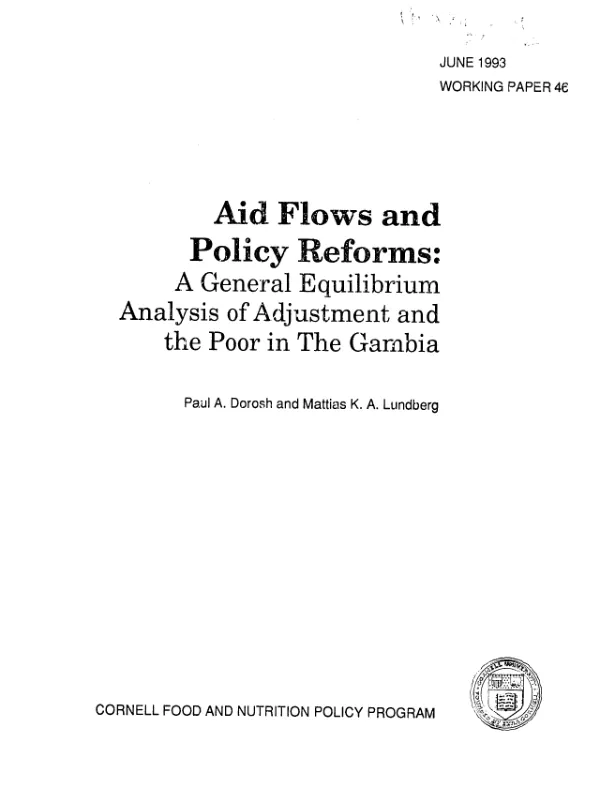
Aid flows and policy reforms : a general equilibrium analysis of adjustment and the poor in The Gambia
Sign inCORNELL UNIVERSITY. DIV. OF NUTRITIONAL SCIENCES. CORNELL FOOD AND NUTRITION POLICY PROGRAM
Aid flows and policy reforms : a general equilibrium analysis of adjustment and the poor in The Gambia
The Gambia"s Economic Recovery Program (which was begun independently, and later supported by USAID and other donors) is an example of a structural adjustment program which significantly increased economic equity in the country.
Dorosh, Paul A.; Lundberg, Mattias K. A. · 1993
Sign in to readA free account is required to download.
Abstract
Thus concludes this study, which uses a computable general equilibrium (CGE) model to examine the program"s effects on economic growth and income distribution. The study first describes the Gambian economy and discusses the country"s experiences during the past decade of policy reform and structural adjustment, with specific emphasis on policies that had the greatest impact. The Gambia CGE model is then described in detail, and simulations of external shocks and policy measures undertaken as part of the Economic Recovery Program are presented. The study concludes that for the most part the improvements in income level and income distribution that occurred in The Gambia were the result of changes in exogenous factors and increased capital inflows, and not the direct results of policy reform. Several general lessons emerge. (1) Foreign aid inflows can provide a significant cushion to mitigate the negative effects of adjustment on the urban poor. (2) Reduced government expenditures will not necessarily benefit rural areas in the long run if private investment is not forthcoming. (3) In The Gambia, groundnut pricing policies have significant effects, with clear tradeoffs between urban and rural incomes. An appendix contains details concerning the social accounting matrix used in this study.