USAID DEC
AidData’s Sector Coding Scheme
The AidData Sector Coding Scheme is a comprehensive framework for categorizing development assistance projects.
2011 · 25 pages
Sign in to readA free account is required to download.
Abstract
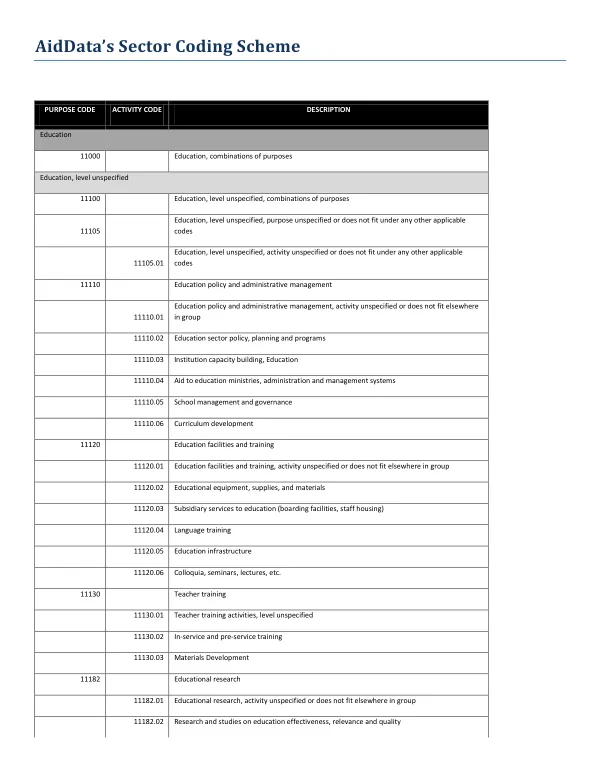
The scheme is organized into several sectors, including Education, Health, Population Policies/Programs and Reproductive Health, and Water Supply and Sanitation. The Education sector is further divided into sub-sectors, including Basic Education, Secondary Education, Post-Secondary Education, and Vocational Training. Each sub-sector is then broken down into more specific categories, such as Education Policy and Administrative Management, Education Facilities and Training, and Teacher Training. The Health sector is also divided into sub-sectors, including Health, General, Basic Health, and Infectious and Parasitic Disease Control. Each sub-sector is further categorized into more specific areas, such as Health Policy and Administrative Management, Medical Education/Training, and Medical Research. The Population Policies/Programs and Reproductive Health sector includes sub-sectors such as Population Policy and Administrative Management, Reproductive Health Care, and Family Planning. The Water Supply and Sanitation sector is divided into sub-sectors such as Water Resources Policy and Administrative Management, Water Resources Protection, and Water Supply and Sanitation. The AidData Sector Coding Scheme provides a standardized framework for classifying development assistance projects, allowing for more accurate and consistent tracking of aid flows. The scheme is widely used by development agencies, researchers, and policymakers to analyze and evaluate the effectiveness of development assistance programs. The coding scheme is designed to be comprehensive and inclusive, covering a wide range of development activities and sectors. It provides a detailed and nuanced classification system, allowing for the identification of specific project activities and outcomes. The scheme is also flexible and adaptable, allowing for the addition of new categories and sub-categories as needed. The AidData Sector Coding Scheme has several key benefits, including improved data quality and consistency, enhanced analytical capabilities, and better decision-making. It provides a common language and framework for development agencies, researchers, and policymakers to communicate and collaborate more effectively. The scheme is also widely used in research and analysis, providing a valuable resource for understanding development trends and outcomes. The coding scheme is regularly updated and refined to reflect changing development priorities and needs. It is maintained by AidData, a research center at the College of William & Mary, in collaboration with development agencies and other stakeholders. The scheme is widely recognized and respected as a leading framework for classifying development assistance projects.