USAID DEC
Aide Mémoire pour Vaccinateurs: Comment Conserver les Vaccins
Vaccination programs require strict adherence to vaccine storage guidelines to maintain their efficacy.
1 pages
Sign in to readA free account is required to download.
Abstract
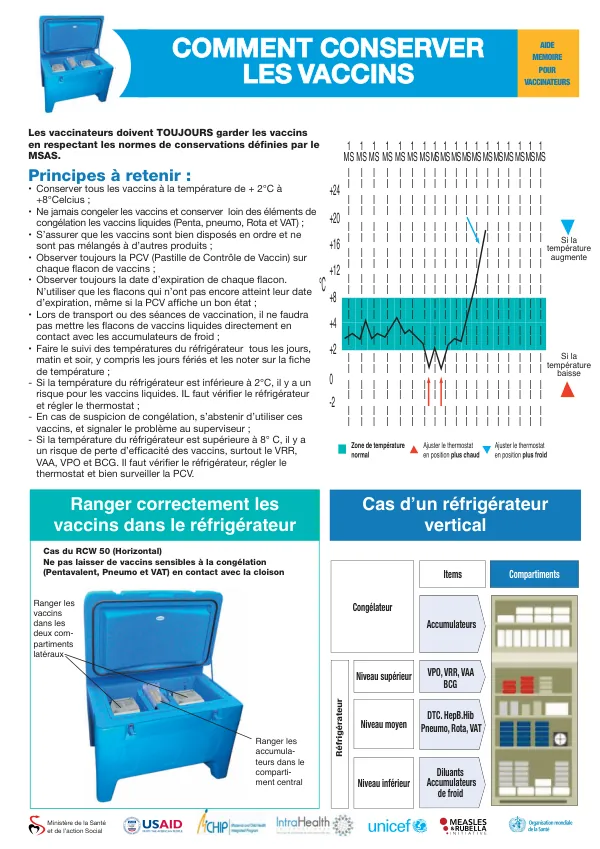
The Ministère de la Santé et de l'action Social has established standards for vaccine conservation, which must be followed at all times. Temperature control is a critical aspect of vaccine storage. Vaccines must be stored at a temperature range of +2°C to +8°C. Liquid vaccines, including Pentavalent, Pneumo, Rota, and VAT, must not be frozen and should be kept away from freezing elements. Vaccines should be arranged in a specific order, with each type stored separately from other products. Regular monitoring of vaccine storage conditions is essential. The Pastille de Contrôle de Vaccin (PCV) on each vaccine vial should be checked regularly, and only vials with an expiration date not yet reached should be used, even if the PCV appears to be in good condition. During transportation or vaccination sessions, liquid vaccine vials should not be placed directly in contact with cold accumulators. Temperature checks should be performed daily, both in the morning and evening, including on holidays and weekends. If the refrigerator temperature falls below 2°C, there is a risk to liquid vaccines, and the refrigerator should be checked and the thermostat adjusted. In the event of suspected freezing, the use of affected vaccines should be discontinued, and the issue reported to a supervisor. If the refrigerator temperature exceeds 8°C, there is a risk of vaccine efficacy loss, particularly for VRR, VAA, VPO, and BCG vaccines. The refrigerator should be checked, the thermostat adjusted, and the PCV closely monitored. Proper storage of vaccines in the refrigerator is also crucial. In a vertical refrigerator, vaccines should be stored in the two lateral compartments, with accumulators in the central compartment. In a horizontal refrigerator, such as the RCW 50, vaccines should be stored in a specific arrangement to prevent sensitive vaccines from coming into contact with the refrigerator wall. Temperature control is critical to maintaining vaccine efficacy. A temperature range of +2°C to +8°C is required for vaccine storage. If the refrigerator temperature falls below 2°C or exceeds 8°C, the storage conditions should be adjusted accordingly. Regular monitoring of vaccine storage conditions is essential to prevent vaccine efficacy loss.
Related documents