USAID DEC
AIDSTAR-One Case Study. Rwanda’s Mixed Epidemic: Results-based Strategy Refocuses Prevention Priorities
Sign inJOHN SNOW INTERNATIONAL
AIDSTAR-One Case Study. Rwanda’s Mixed Epidemic: Results-based Strategy Refocuses Prevention Priorities
Rwanda's national HIV program was nearly fully funded for all activities in 2009, with primary support from the Global Fund to Fight AIDS, Tuberculosis and Malaria (GFATM) and the U.S.
2012 · 16 pages
Sign in to readA free account is required to download.
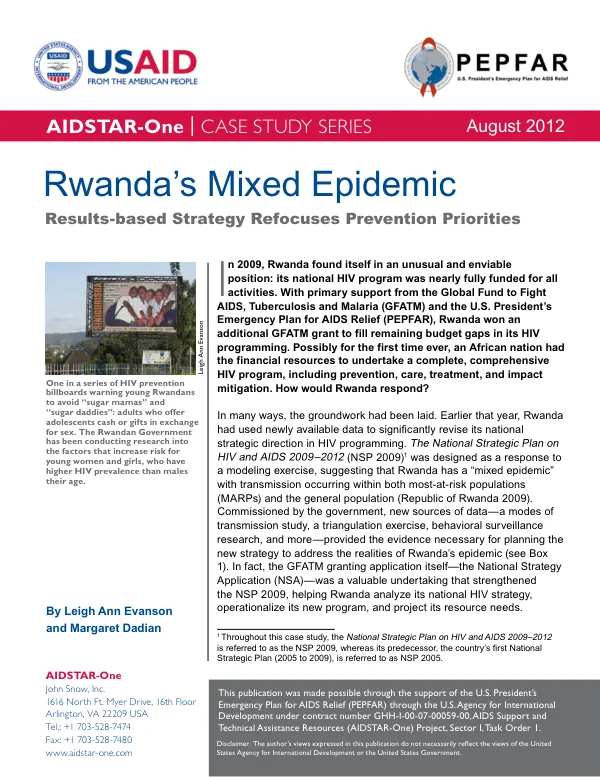
Abstract
President's Emergency Plan for AIDS Relief (PEPFAR). Rwanda won an additional GFATM grant to fill remaining budget gaps in its HIV programming, making it the first African nation to have the financial resources to undertake a complete, comprehensive HIV program, including prevention, care, treatment, and impact mitigation. The groundwork for this achievement had been laid earlier in 2009, when Rwanda used newly available data to significantly revise its national strategic direction in HIV programming. The National Strategic Plan on HIV and AIDS 2009-2012 (NSP 2009) was designed as a response to a modeling exercise, suggesting that Rwanda has a "mixed epidemic" with transmission occurring within both most-at-risk populations (MARPs) and the general population. The NSP 2009 was developed through a broadly participatory process that brought together hundreds of stakeholders from various sectors, who contributed diverse perspectives and expertise. Rwanda's mixed epidemic is characterized by a low HIV prevalence of 3 percent among the general adult population aged 15 to 49, but higher prevalence among specific at-risk populations, including sex workers in Kigali with 57 percent prevalence. Vulnerable subpopulations within the general population also show higher HIV prevalence, such as women 20 to 24 years old, who have a prevalence five times that of men their age. There is also geographic variability, with higher HIV prevalence in urban areas (7.3 percent) than in rural areas (2.2 percent). In response to the mixed nature of HIV transmission, Rwanda reoriented its priorities and redesigned its strategies to be more targeted and cost-effective. The country recognized the need to focus on vulnerable groups and adopted a data-based approach to planning, which involved commissioning several key studies to gather new data on MARPs. These studies included an exploratory study on behaviors that put Rwandan men who have sex with men (MSM) in Kigali at high risk, a modes of transmission study, and a data triangulation exercise that combined information from earlier research to detect epidemiological trends in different populations. The NSP 2009 and other strategy documents provided concrete goals and objectives for stakeholders, making all parties responsible for success. The broadly participatory nature of the planning process brought together hundreds of stakeholders from many sectors, who contributed diverse perspectives and a broad array of experience and expertise. The result was a bold move away from planning based on re-implementing traditional program activities toward an ambitious, evidence-based, comprehensive strategy responsive to the nature of Rwanda's epidemic. Rwanda's recognition of the mixed nature of HIV transmission within its borders prompted the country to reorient its priorities and redesign its strategies to be more targeted and cost-effective. These efforts have put Rwanda among a handful of nations on the continent whose governments are gathering evidence on MARPs and targeting prevention programming to them. The country's experience presents important lessons learned and suggests promising practices for other countries with a similar epidemiological profile.
Related documents
Documents in this collection
 2012
2012USAID DEC
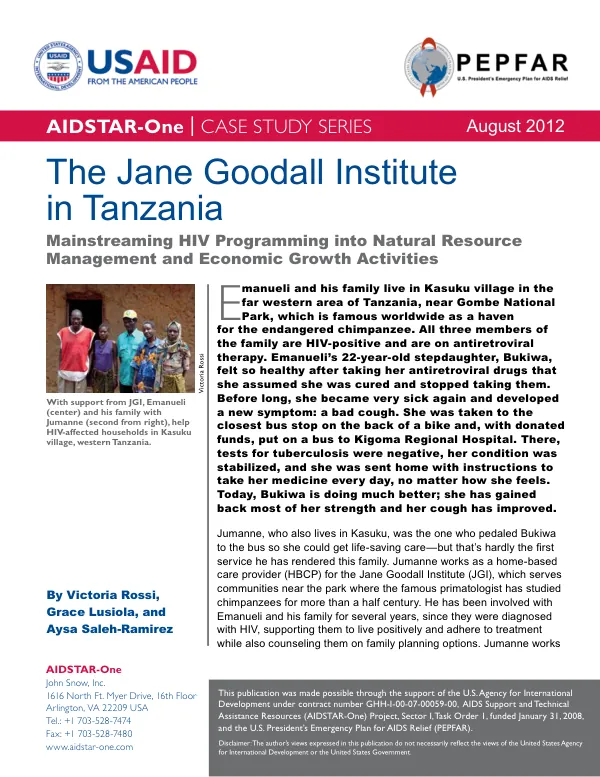
The Jane Goodall Institute in Tanzania: Mainstreaming HIV Programming into Natural Resource Management and Economic Growth Activities
Open record 2012
2012USAID DEC
2012 International AIDS Conference: Where the Tide Will Turn: How is Community Level Participation Most Effective in Turning The Tide?
Open record