FEDERAL MINISTRY OF HEALTH
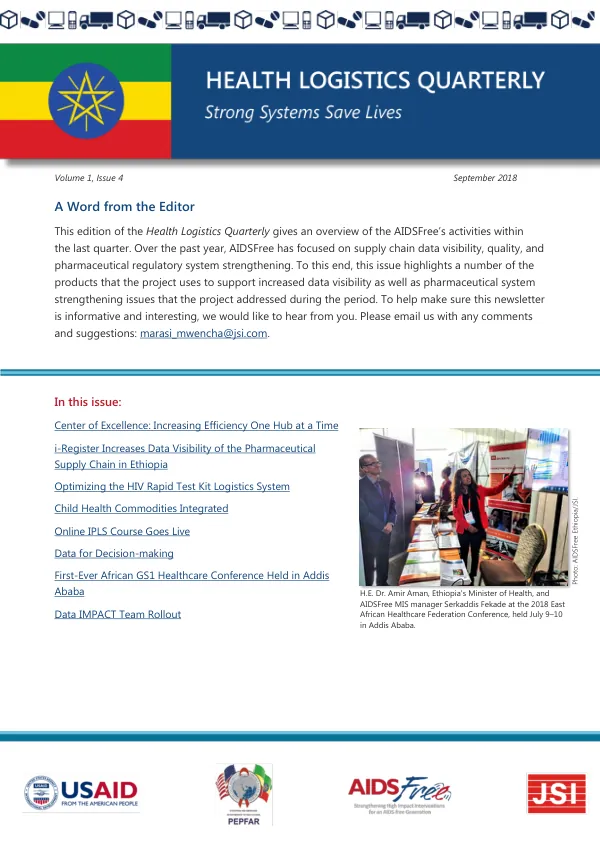
Health Logistics Quarterly: September 2018
The AIDSFree project in Ethiopia has focused on supply chain data visibility, quality, and pharmaceutical regulatory system strengthening over the past year.
2018 · 11 pages
Sign in to readA free account is required to download.
Abstract
To support increased data visibility, the project has developed several products, including the i-Register system. i-Register is a web-based, open-source management information system that automates medical product registration application, screening, review, and market authorization. The system allows applicants to submit market authorization requests and track the status of their applications online. The i-Register system has been implemented in Ethiopia and has reduced the days needed to process an average application from 176 to 31. The system also allows for remote submission, eliminating the need for applicants to deliver hard-copies to the Ethiopia Food, Medicine, Health Care Administration and Control Authority (FMHACA). FMHACA and clients are using i-Register on a daily basis, with clients submitting market authorization requests and FMHACA staff processing the applications. In addition to i-Register, the AIDSFree project has also been working to optimize the HIV rapid test kit logistics system. The Federal Ministry of Health (FMOH) has established a task force to develop a feasible design option for RTK supply management. The task force has designed an optimal RTK supply chain system that leverages the Integrated Public Logistics System (IPLS) and considers use of both logistics and service data for RTK resupply decision-making. A supplemental standard operating procedures (SOPs) manual has been developed to serve as a guidance and reference document for implementation of the newly designed RTK logistics system. The Federal Ministry of Health (FMOH) of Ethiopia has a strategic plan to reduce child mortality and enhance child survival, especially in children under five. The Pharmaceuticals Fund and Supply Agency (PFSA) is working to ensure uninterrupted and sustainable supply of child health commodities at all levels through its 19 hubs, using an integrated approach. The PFSA has been working to ensure a sustainable supply of HIV rapid test kits (RTKs) at all testing and counseling service delivery points, with a focus on efficient identification of HIV-positive individuals through targeted HIV testing. The Center of Excellence is an initiative aimed at increasing the efficiency of the Pharmaceuticals Fund and Supply Agency (PFSA) by focusing on three main areas: warehouse management system optimization, monitoring and evaluation, and reviewing and increasing distribution frequency. The pilot program will be launched in late September at the Adama hub of the PFSA, with representatives from government agencies, implementing partner organizations, and donor agencies expected to be on hand. The program will be piloted at the Adama hub and then scaled up to all 19 hubs, with the goal of supporting an increase in efficiency and ultimately improved patient health outcomes. The Federal Ministry of Health (FMOH) has been working to ensure an efficient logistics system to ensure a sustainable supply of RTKs at all testing and counseling service delivery points. The current HTS focus is on efficient identification of HIV-positive individuals through targeted HIV testing, with the significant measure being yield, the relative number of HIV-positive individuals being identified, rather than on volume of tests performed across HTS provision points. The current RTK supply chain system is characterized by non-standardized product and information flow, long, multilevel, inefficient supply chain, irregular distribution practices, and weak coordination mechanisms.