THE NATIONAL DEMOCRATIC INSTITUTE
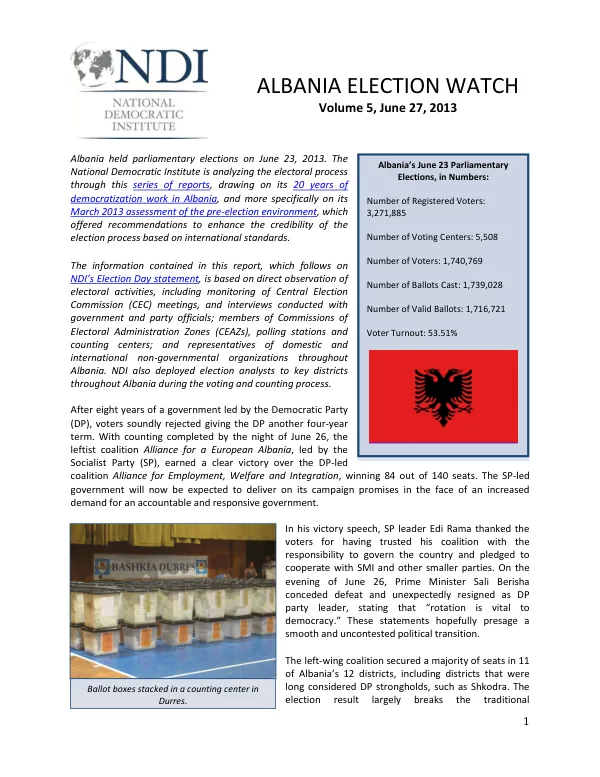
Albania's June 23 Parliamentary Elections, in Numbers
Albania held parliamentary elections on June 23, 2013.
2013 · 4 pages
Sign in to readA free account is required to download.
Abstract
The National Democratic Institute analyzed the electoral process through this series of reports, drawing on its 20 years of democratization work in Albania, and more specifically on its March 2013 assessment of the pre-election environment, which offered recommendations to enhance the credibility of the election process based on international standards. The information contained in this report is based on direct observation of electoral activities, including monitoring of Central Election Commission (CEC) meetings, and interviews conducted with government and party officials; members of Commissions of Electoral Administration Zones (CEAZs), polling stations and counting centers; and representatives of domestic and international non-governmental organizations throughout Albania. NDI also deployed election analysts to key districts throughout Albania during the voting and counting process. After eight years of a government led by the Democratic Party (DP), voters soundly rejected giving the DP another four-year term. With counting completed by the night of June 26, the leftist coalition Alliance for a European Albania, led by the Socialist Party (SP), earned a clear victory over the DP-led coalition Alliance for Employment, Welfare and Integration, winning 84 out of 140 seats. The SP-led government will now be expected to deliver on its campaign promises in the face of an increased demand for an accountable and responsive government. In his victory speech, SP leader Edi Rama thanked the voters for having trusted his coalition with the responsibility to govern the country and pledged to cooperate with SMI and other smaller parties. On the evening of June 26, Prime Minister Sali Berisha conceded defeat and unexpectedly resigned as DP party leader, stating that "rotation is vital to democracy." These statements hopefully presage a smooth and uncontested political transition. The left-wing coalition secured a majority of seats in 11 of Albania's 12 districts, including districts that were long considered DP strongholds, such as Shkodra. The election result largely breaks the traditional North/South division of Albanian politics, with the North supporting the right and the South supporting the left. The only district the DP-led coalition won was the small northern district of Kukes. The SP-led coalition is now poised to enter government, with SP leader Edi Rama heavily favored to be Albania's next prime minister. At 53.51 percent, voter turnout was higher than in past Albanian elections. While the left has swept into government with a clear mandate, the SP only increased its number of seats from 2009 by one – from 65 to 66 – and its share of the popular vote by 0.7 percent. Voters, rather than embracing the SP as the alternative force for change, looked to smaller parties – primarily the Socialist Movement for Integration (SMI). The SMI, which was a junior governing coalition partner until forming a pre-election coalition with the SP in April, dramatically increased its seats in parliament from four to 16. Smaller coalition parties, like the Republican Party (RP) and the Party for Justice, Union and Integration (PDIU), also made incremental increases, with RP increasing its share of seats from one to three and PDIU from one to four seats, with both of their leaders also winning separately on the DP ticket. Some speculate that this increase may be attributed to right-wing supporters switching their support from the DP. New parties – including former president Bamir Topi's New Democratic Spirit (NDS) and the nationalistic Red and Black Alliance (RBA) – failed to secure representation in the parliament. Independent candidates Arben Malaj, a former SP member of parliament (MP) running in Vlora, and Dritan Prifti, a former SMI minister running in Durres, also failed to secure seats. The number of women in parliament increased only marginally from 23 to 25. Economic issues, primarily related to job creation and tax policy, were the top priorities of citizens during the campaign. The electoral result clearly revealed voters' frustrations with Albania's high unemployment rate and poor social services. Interlocutors with whom NDI spoke described these elections as a triumph of the Albanian public and a distinct sign that voters finally recognize the power of their vote to affect change. In a telling moment, one police officer and self-described DP-supporter informed NDI he was happy with the elections, calling them "a true reflection of the people's will," encapsulating the frustration felt by many Albanians with the numerous controversial and disputed elections of the last 20 years. The CEC continued to operate with only four members, as detailed in previous NDI reports. Despite concerns about the body's ability to operate impartially on the voting and counting days, the CEC mainly took decisions to address non-controversial administrative issues, such as the substitution of CEAZ members and replacing missing electoral materials. With the SP stating that its nominated CEC members would not return to the body, uncertainty remains over the certification of the election results, which the CEC cannot do with only four votes. The certification process,