USAID DEC
Electoral Assistance After Action (EA3) Review: USAID Support to Nepal's 2022 Electoral Cycle
Sign inTHE CLOUDBURST GROUP
Electoral Assistance After Action (EA3) Review: USAID Support to Nepal's 2022 Electoral Cycle
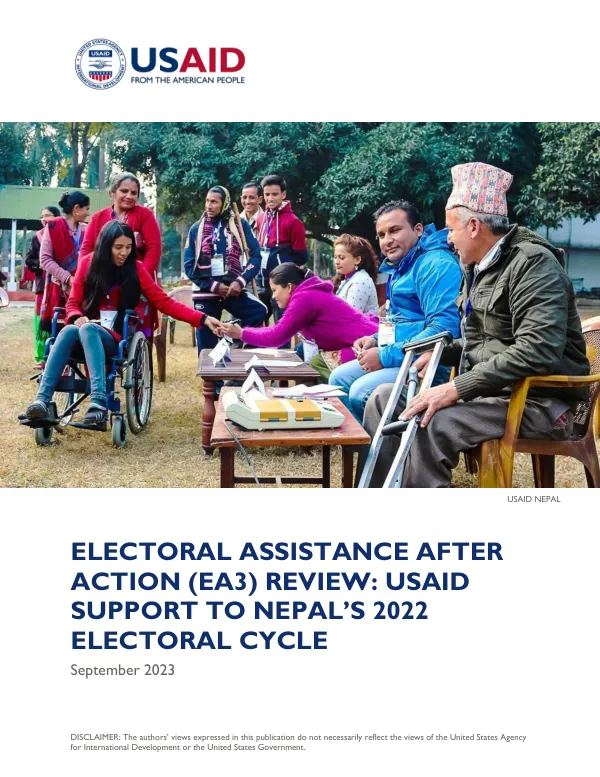
The 2022 electoral cycle in Nepal was viewed by key electoral stakeholders as largely peaceful and credible.
2023 · 41 pages
Sign in to readA free account is required to download.
Abstract
The Election Commission of Nepal (ECN) generally had the confidence of key electoral stakeholders and announced results that were seen as legitimate by voters, parties, and candidates. These elections were the second elections since the 2015 Constitution, which enacted a decentralized system of governance. The 2022 elections were also seen by many to be a key benchmark in Nepal's lengthy, complex, and ongoing political transition from conflict to peaceful democratic governance. Nepal is a relatively young democracy, though it had a short but impactful interlude in the 1950s where political parties were established after the end of the Rana regime. A long period of political processes without parties followed shortly thereafter, however, and it was not until the 1990s that party politics returned. Nepal's more recent political history provides an important backdrop to the 2022 elections. Several key contextual issues, including the Maoist insurgency, the 2006 Comprehensive Peace Accord, and the 2015 Constitution, have shaped the country's electoral landscape. The 2022 elections were the first to be held under the 2015 Constitution, which introduced a new system of governance and electoral processes. The elections were also the first to be held after the dissolution of the Nepal Communist Party (NCP), which had been in power since 2018. The elections saw the emergence of new political parties and alliances, including the Maoist Centre and the Unified Marxist Leninist (UML) party. The elections were also marked by a significant increase in the number of women candidates, with over 30% of candidates being women. The USAID-supported electoral assistance program in Nepal aimed to support the ECN in conducting free, fair, and transparent elections. The program provided technical assistance to the ECN, including support for voter registration, election observation, and electoral dispute resolution. The program also supported the development of electoral infrastructure, including the establishment of a new electoral management information system. The assessment team conducted a desk review prior to fieldwork in Nepal, reviewing USAID/USAID Nepal program documents, external reports of relevant information about Nepal's political context and elections, and other relevant documentation. Fieldwork took place from April 5 to April 21, 2023, in Kathmandu, Nepal, and involved conducting 47 key informant interviews (KIIs) with a broad set of stakeholders from USAID/Nepal, USAID implementation partners, the ECN, political parties, elected officials, civil society organizations (CSOs), international donors, and technical assistance providers. The assessment team found that the USAID-supported electoral assistance program in Nepal made significant contributions to the conduct of the 2022 elections. The program's technical assistance to the ECN helped to improve the efficiency and effectiveness of the electoral process, while the program's support for electoral infrastructure development helped to enhance the transparency and accountability of the electoral process. The assessment team also found that the program's support for civil society organizations (CSOs) helped to promote the participation of marginalized groups in the electoral process. The assessment team identified several key lessons and reflections from the USAID-supported electoral assistance program in Nepal. These included the importance of building strong relationships with key stakeholders, including the ECN and CSOs, and the need for flexible and adaptive programming to respond to changing electoral contexts. The assessment team also highlighted the importance of supporting the development of electoral infrastructure, including the establishment of a new electoral management information system. Overall, the assessment team found that the USAID-supported electoral assistance program in Nepal made significant contributions to the conduct of the 2022 elections. The program's technical assistance to the ECN, support for electoral infrastructure development, and support for CSOs all helped to promote the transparency, accountability, and inclusiveness of the electoral process.