USAID DEC
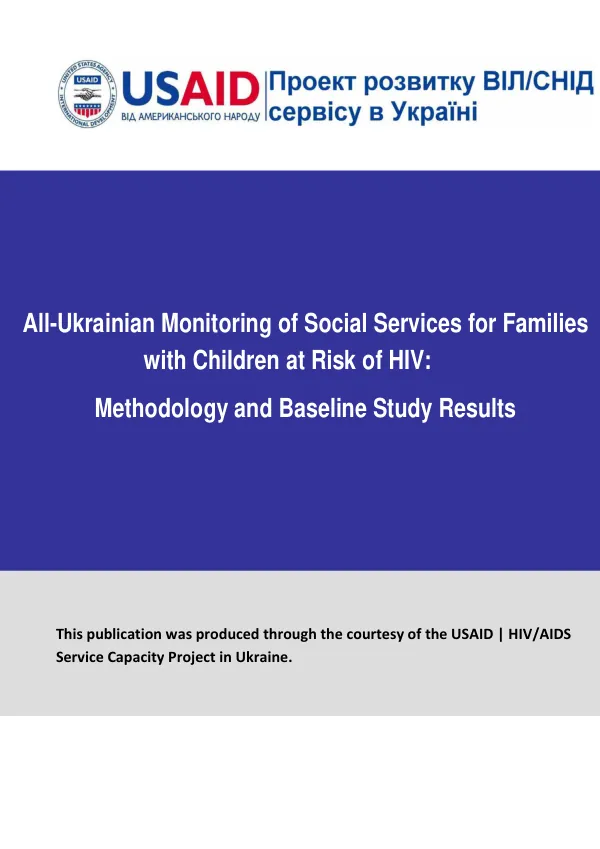
All-Ukrainian Monitoring of Social Services for Families with Children at Risk of HIV: Methodology and Baseline Study Results
Sign inUSAID DEC
All-Ukrainian Monitoring of Social Services for Families with Children at Risk of HIV: Methodology and Baseline Study Results
The All-Ukrainian Monitoring of Social Services for Families with Children at Risk of HIV: Methodology and Baseline Study Results was conducted to analyze the provision of social services to families affected by the HIV/AIDS epidemic in Ukraine.
2012 · 185 pages
Sign in to readA free account is required to download.
Abstract
The monitoring was commissioned by the Ministry of Social Policy and implemented by the USAID | HIV/AIDS Service Capacity Project in Ukraine. The study aimed to assess the access of families with children at risk of HIV to various social services, including psychological assistance, legal services, social services, summer camps for children from families vulnerable to HIV, and services to prepare children for school. The study also examined services aimed at families with HIV-positive children, such as training on caring for and raising children born to HIV-positive mothers, developing adherence to antiretroviral therapy, ensuring formula feeding of infants born to HIV-positive mothers, and social and psychological assistance in disclosing the child's or parent's HIV status. The study found that families with children at risk of HIV face significant challenges, including a lack of access to social services, stigma and discrimination, and limited financial resources. The study also identified gaps in the provision of social services, including a lack of specialized services for families with HIV-positive children and inadequate support for families in difficult life circumstances. The study recommended that social services for families at risk of HIV be improved through the development of specialized services, increased funding, and enhanced training for social workers. The study also emphasized the importance of addressing stigma and discrimination against people living with HIV/AIDS and their families. The study was conducted by the Analytical Center "Socioconsulting" at the request of the Ministry of Social Policy of Ukraine, with the support of the USAID | HIV/AIDS Service Capacity Project in Ukraine. The study's methodology involved a survey of experts and families with children at risk of HIV, as well as an analysis of existing social services and policies. The study's findings and recommendations are intended to inform the development of social services for families at risk of HIV in Ukraine and to contribute to the improvement of the country's response to the HIV/AIDS epidemic. The study's results are also relevant to other countries in the region that are facing similar challenges in providing social services to families affected by the epidemic. The study's authors identified several key trends in the development of social services for families at risk of HIV in Ukraine. These trends include the increasing number of families with HIV-positive children, the growing need for specialized services, and the importance of addressing stigma and discrimination against people living with HIV/AIDS and their families. The study's conclusions and recommendations are based on the analysis of the study's findings and the existing literature on social services for families at risk of HIV. The study's authors emphasized the importance of a comprehensive approach to addressing the needs of families affected by the epidemic, including the provision of social services, support for families in difficult life circumstances, and the development of specialized services for families with HIV-positive children. The study's methodology involved a survey of experts and families with children at risk of HIV, as well as an analysis of existing social services and policies. The study's results are based on the analysis of the survey data and the existing literature on social services for families at risk of HIV. The study's authors identified several key indicators that were used to assess the access of families with children at risk of HIV to social services. These indicators included the availability of psychological assistance, legal services, social services, summer camps for children from families vulnerable to HIV, and services to prepare children for school. The study's recommendations emphasized the importance of addressing stigma and discrimination against people living with HIV/AIDS and their families, as well as the need to improve the availability and quality of social services for families at risk of HIV. The study also recommended that social services be developed in a way that takes into account the specific needs of families with HIV-positive children and families in difficult life circumstances. The study's findings and recommendations are intended to inform the development of social services for families at risk of HIV in Ukraine and to contribute to the improvement of the country's response to the HIV/AIDS epidemic. The study's results are also relevant to
Related documents
Documents in this collection
USAID DEC
Primary Health Care Reform in the City of Kiev, and Dniepropetrovsk and Zhitomir Oblasts
Open record
USAID DEC
An Assessment of Plans to Implement per Capita Financing in the Health System of L'viv Oblast
Open record
USAID DEC