USAID
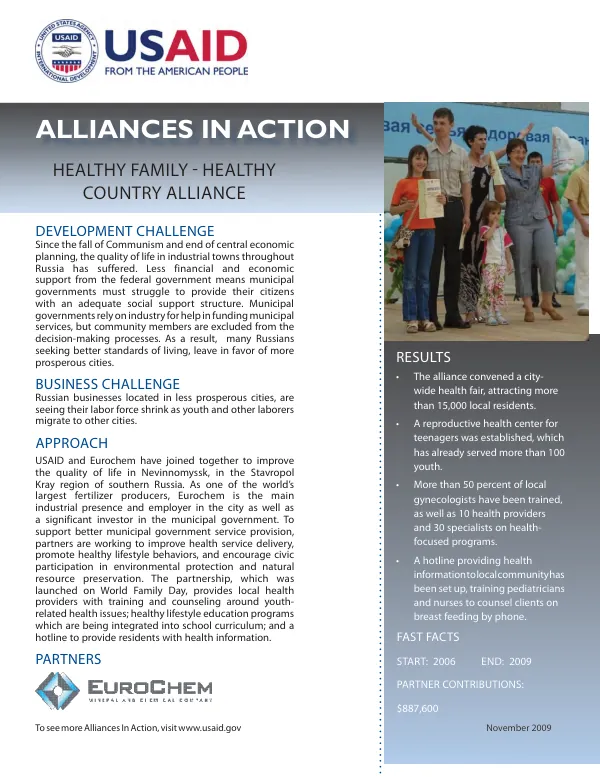
ALLIANCEs IN action: RESULTS
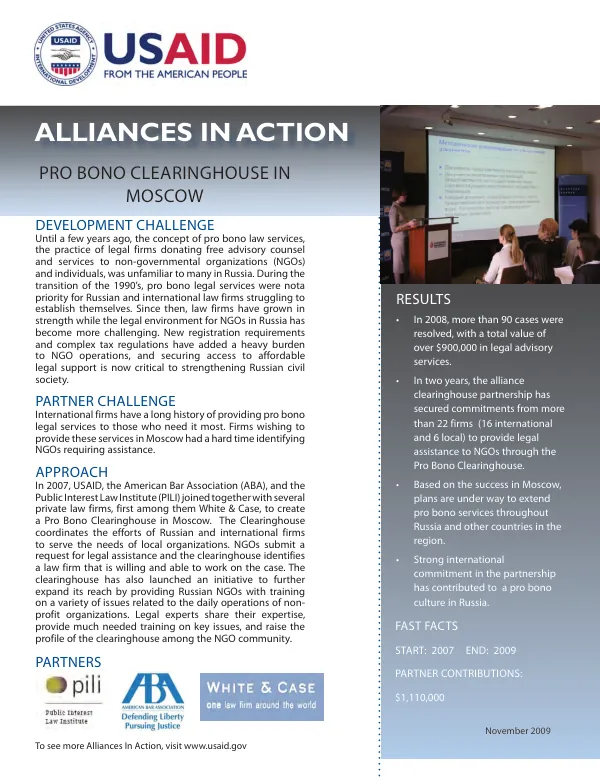
The Pro Bono Clearinghouse in Moscow was established in 2007 through a partnership between USAID, the American Bar Association (ABA), and the Public Interest Law Institute (PILI), along with several private law firms, including White & Case.
2009 · 1 pages
Sign in to readA free account is required to download.
Abstract
The primary objective of the Clearinghouse was to coordinate the efforts of Russian and international firms to provide pro bono legal services to local non-governmental organizations (NGOs). This initiative aimed to address the growing need for affordable legal support among Russian NGOs, which faced increased regulatory burdens and complex tax regulations. The Clearinghouse facilitated the provision of pro bono services by identifying NGOs in need of assistance and matching them with law firms willing and able to work on their cases. In addition to case coordination, the Clearinghouse launched an initiative to provide training to Russian NGOs on various issues related to non-profit operations. Legal experts shared their expertise, provided training on key issues, and raised the profile of the Clearinghouse among the NGO community. The Pro Bono Clearinghouse in Moscow secured commitments from more than 22 firms, including 16 international and 6 local firms, to provide legal assistance to NGOs through the Pro Bono Clearinghouse. This strong international commitment contributed to the development of a pro bono culture in Russia. The Clearinghouse's efforts resulted in the resolution of over 90 cases in 2008, with a total value of over $900,000 in legal advisory services. The success of the Pro Bono Clearinghouse in Moscow led to plans to extend pro bono services throughout Russia and other countries in the region. This expansion aimed to address the growing need for affordable legal support among NGOs in these countries. The Clearinghouse's model has the potential to be replicated in other regions, providing a framework for the coordination of pro bono services and the development of a pro bono culture. The Pro Bono Clearinghouse in Moscow received significant funding from its partners, with total contributions of $1,110,000 between 2007 and 2009. This investment enabled the Clearinghouse to establish a robust infrastructure and provide critical support to Russian NGOs. The Clearinghouse's success demonstrates the potential for public-private partnerships to address development challenges and promote the rule of law in emerging markets.
Related documents