USAID DEC
Altered substrate specificity of the Pterygoplichthys sp. (Loricariidae) CYP1A enzyme
Sign inUSAID DEC
Altered substrate specificity of the Pterygoplichthys sp. (Loricariidae) CYP1A enzyme
The Pterygoplichthys sp.
2014 · 1 pages
Sign in to readA free account is required to download.
Abstract
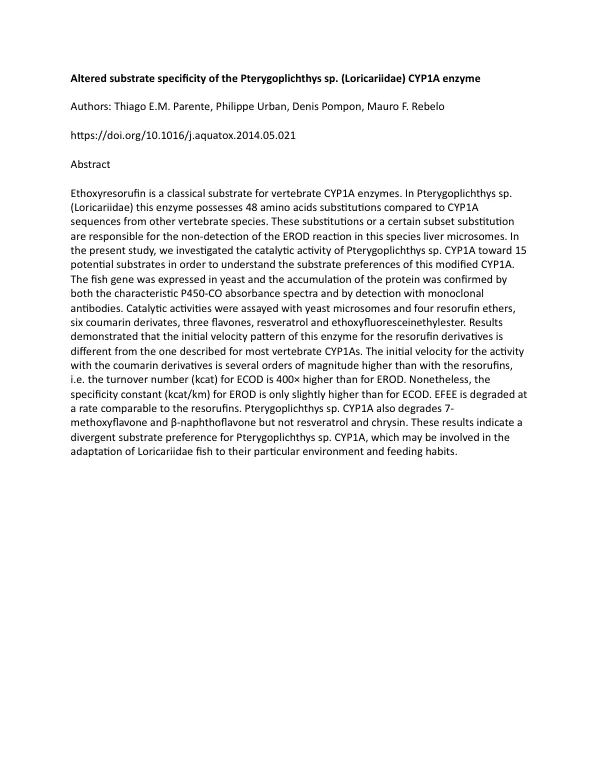
(Loricariidae) CYP1A enzyme exhibits altered substrate specificity compared to its counterparts in other vertebrate species. This enzyme possesses 48 amino acid substitutions, which are responsible for the non-detection of the EROD reaction in liver microsomes of this species. To understand the substrate preferences of this modified CYP1A, researchers investigated its catalytic activity toward 15 potential substrates. The fish gene was expressed in yeast, and the accumulation of the protein was confirmed by both the characteristic P450-CO absorbance spectra and detection with monoclonal antibodies. Catalytic activities were assayed with yeast microsomes and various substrates, including four resorufin ethers, six coumarin derivatives, three flavones, resveratrol, and ethoxyfluorescein ethylester. The results demonstrated that the initial velocity pattern of this enzyme for the resorufin derivatives is different from the one described for most vertebrate CYP1As. The initial velocity for the activity with the coumarin derivatives is several orders of magnitude higher than with the resorufins, indicating a distinct substrate preference. The turnover number (kcat) for ECOD is 400 times higher than for EROD, yet the specificity constant (kcat/km) for EROD is only slightly higher than for ECOD. Additionally, EFEE is degraded at a rate comparable to the resorufins. Pterygoplichthys sp. CYP1A also degrades 7-methoxyflavone and β-naphthoflavone but not resveratrol and chrysin. These findings suggest a divergent substrate preference for Pterygoplichthys sp. CYP1A, which may be involved in the adaptation of Loricariidae fish to their particular environment and feeding habits. The results of this study provide new insights into the biochemical properties of this enzyme and its potential role in the ecological niche of the Pterygoplichthys sp. species. The altered substrate specificity of this enzyme may have significant implications for understanding the evolution of CYP1A enzymes in vertebrates and their adaptation to different environments.