UNIVERSITY OF MARYLAND
Evolutionary History of Brassolini
Mesoamerica is a cradle and the Atlantic Forest is a museum of Neotropical butterfly diversity.
2021 · 21 pages
Sign in to readA free account is required to download.
Abstract
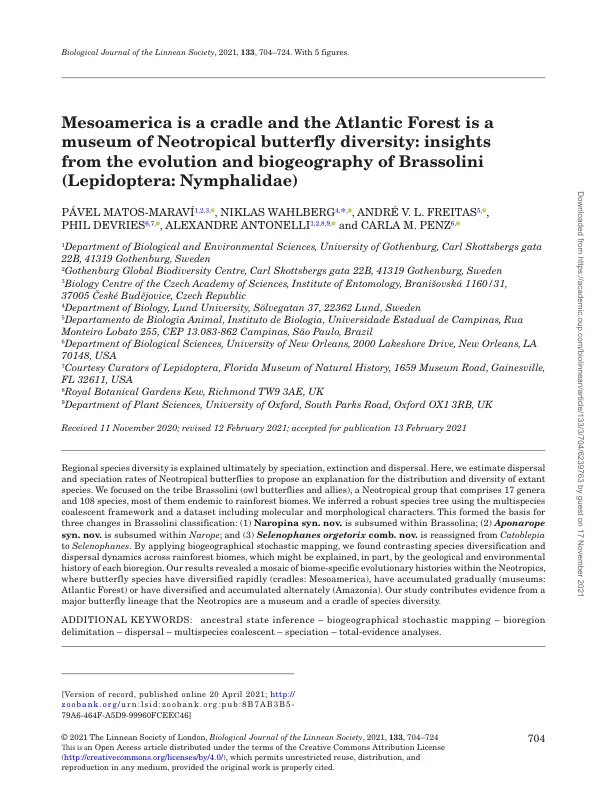
This is evident from the evolution and biogeography of Brassolini, a Neotropical group of butterflies that comprises 17 genera and 108 species. Most of these species are endemic to rainforest biomes. The tribe Brassolini is an exclusively Neotropical monophyletic group, consisting of 17 genera and 108 species found mainly in the rainforests of Mesoamerica, the NW slope of the Andes, the Atlantic Forest, and Amazonia. Regional species diversity is ultimately explained by speciation, extinction, and dispersal. To propose an explanation for the distribution and diversity of extant species, researchers estimated dispersal and speciation rates of Neotropical butterflies. They focused on the tribe Brassolini, which is a Neotropical group that comprises 17 genera and 108 species. The researchers inferred a robust species tree using the multispecies coalescent framework and a dataset including molecular and morphological characters. This formed the basis for three changes in Brassolini classification: (1) Naropina is subsumed within Brassolina; (2) Aponarope is subsumed within Narope; and (3) Selenophanes orgetorix is reassigned from Catoblepia to Selenophanes. Contrasting species diversification and dispersal dynamics across rainforest biomes were found using biogeographical stochastic mapping. These dynamics might be explained, in part, by the geological and environmental history of each bioregion. The results revealed a mosaic of biome-specific evolutionary histories within the Neotropics, where butterfly species have diversified rapidly in Mesoamerica, accumulated gradually in the Atlantic Forest, or diversified and accumulated alternately in Amazonia. This study contributes evidence from a major butterfly lineage that the Neotropics are a museum and a cradle of species diversity. The researchers examined biogeographical patterns for butterflies in the tribe Brassolini, an exclusively Neotropical monophyletic group consisting of 17 genera and 108 species found mainly in the rainforests of Mesoamerica, the NW slope of the Andes, the Atlantic Forest, and Amazonia. A time-calibrated species phylogeny of Brassolini was inferred by merging all previous datasets and generating new DNA and morphological data to infer the diversification and biogeographical histories of these butterflies. The study aimed to assess whether physical connection among Neotropical biomes existed during the Neogene and Quaternary periods, which would be reflected in the timing and magnitude of dispersal and speciation trends through time.