USAID DEC
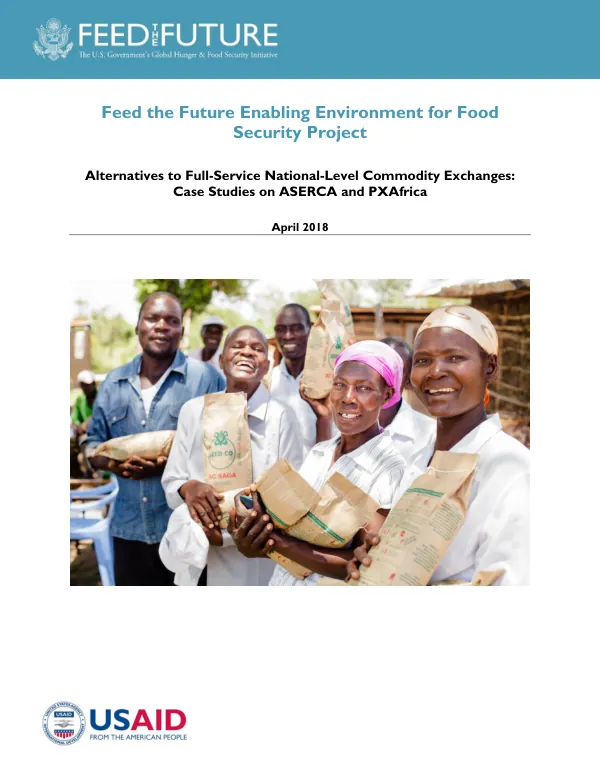
Alternatives to Full-Service National-Level Commodity Exchanges: Case Studies on ASERCA and PXAfrica
Sign inFINTRAC
Alternatives to Full-Service National-Level Commodity Exchanges: Case Studies on ASERCA and PXAfrica
The Feed the Future Enabling Environment for Food Security Project initiated a study to explore alternatives to full-service national-level commodity exchanges.
2018 · 19 pages
Sign in to readA free account is required to download.
Abstract
The study focused on two case studies: the Agencia de Servicios a la Comercialización y Desarrollo de Mercados Agropecuarios (ASERCA) program in Mexico and the PanXchange trading platform in East Africa known as PXAfrica (PXA). ASERCA was established in response to the Mexican government's commitment to cross-border food market liberalization under the North American Free Trade Agreement (NAFTA). The program's objective is to provide commodity price risk management for domestic producers, processors, and wholesalers by facilitating access to international exchanges in New York and Chicago. Key takeaways from the ASERCA program include the importance of liberalizing cross-border commodity trade to correlate domestic commodity prices with international prices, the need for advanced institutional capacity and resources to manage price hedging strategies, and the potential for public sector agencies to stimulate the role of intermediaries in accessing international exchanges. PXA, a web-based over-the-counter (OTC) software platform, facilitates trade in physical commodities in Kenya, Uganda, and Tanzania. The platform does not aim to be a full-service regulated commodity exchange and instead focuses on providing a central location for buyers and sellers to negotiate trade terms and manage counterparty risk. Key features of the PXA platform include the provision of bid prices and offer prices at various geographic locations, automatic generation of binding contracts when terms of trade match, and the breakdown of entry barriers and provision of price transparency across geographies. The report highlights several key takeaways from the experiences of ASERCA and PXA for policymakers, development agencies, and private stakeholders seeking to address the objectives of upgrading physical commodity trade and/or facilitating commodity price risk management. These takeaways include the potential for alternative models to deliver some of the benefits of a commodity exchange without meeting all pre-conditions for a full-service national-level commodity exchange, the importance of considering the operating context and capacities when selecting a solution, and the need for further review to ascertain the relevance and appropriateness of the specific model in a given country's context. The study's findings suggest that targeted enabling environment reforms, including food market liberalization, are critical for the success of commodity exchanges. However, where certain conditions are not yet present to support a full-service national-level commodity exchange, alternative mechanisms such as ASERCA and PXA may be viable options for achieving similar market objectives. The report provides a framework for policymakers and development agencies to consider alternative models and assess their potential for addressing the objectives of upgrading physical commodity trade and/or facilitating commodity price risk management.
Related documents