CNFA, INC.
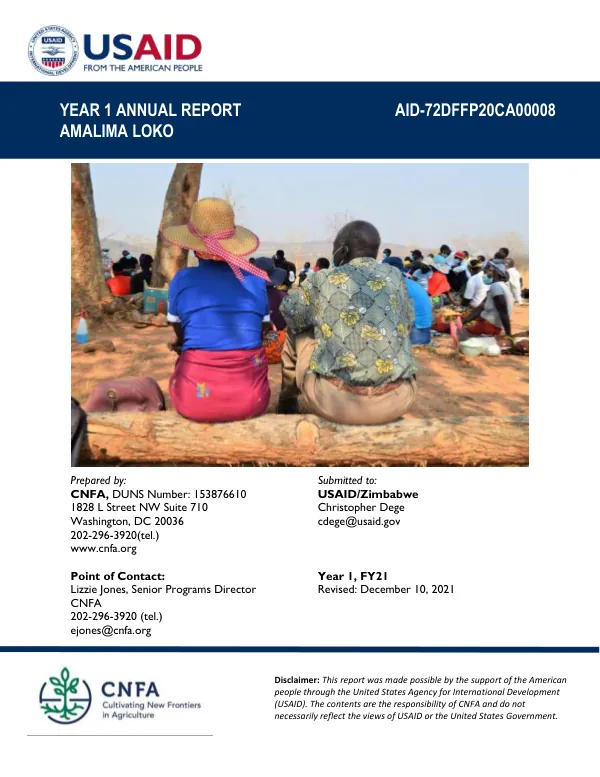
Year 1 Annual Report: Amalima Loko 72DFFP20CA00008
Amalima Loko is a program aimed at improving food and nutrition security through increased food access and sustainable watershed management in rural communal wards of Matabeland North province in Zimbabwe.
2021 · 26 pages
Sign in to readA free account is required to download.
Abstract
The program is implemented by CNFA and is funded by USAID. The geographic area of focus includes 87 rural communal wards in five districts of Matabeland North province, with a total population of approximately 166,000. The program's Theory of Change (TOC) was refined in Year 1, with a focus on clarifying the language and causal logic. The TOC was reviewed and streamlined by the Amalima Loko team, with input from the Program Cycle Support (PCS) team and USAID. The refinement process helped to present a clearer and simpler version of the TOC for the Inception Workshop. The Inception Workshop was held in January and February 2021, and it included components such as a Gender Consultation, Reviewing and Prioritizing Information Gaps, and a Community Engagement Roundtable. The Inception Workshop was conducted in a fully remote format due to COVID-19 restrictions, which presented some challenges for participation. However, the workshop was productive and met its objectives, and it resulted in a prioritized list of information gaps that served as the basis for planning Refine and Implement (R&I) studies and for future refinement of the Amalima Loko TOC. The workshop also built the Amalima Loko team's understanding of the R&I process and expectations, set the stage for ongoing collaboration between BHA and program staff, and ensured that each team member began with a shared understanding of community engagement priorities and gender, youth, and social dynamics (GYSD) considerations. The Amalima Loko TOC was updated in Q2 and Q3 of Year 1, with input from Justin Mupeyiwa, BHA M&E Specialist, and the Amalima Loko M&E Lead and technical teams. The main updates to the TOC include realigning the causal logic for Sub-purpose 1.1 to reflect that improved planning is descriptive of the Intermediate Outcomes (IOs) leading to the revised Sub-purpose 1.1 "Use of communal resources optimized to maximize inclusive community benefits." The team also streamlined and updated language for each of the IOs to more clearly reflect feasible objectives. The program successfully imported 280 metric tons of commodities and placed a second call forward in June, with commodities in transit at the end of the fiscal year. In the second half of the fiscal year, Amalima Loko began engaging directly with communities, distributing rations to 14,133 unique participants with the Blanket Supplementary Feeding Program (BSFP) and engaging 4,851 participants in Community Visioning meetings. The program's acceptance by communities and engagement with government stakeholders has been excellent, despite some limitations due to COVID-19 lockdowns.
Related documents