USAID DEC
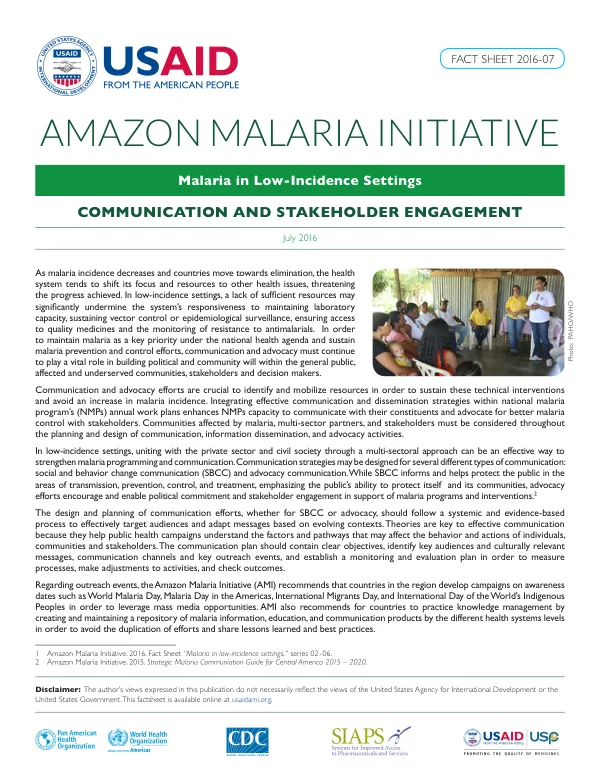
Amazon Malaria Initiative FACT SHEET 2016-07 Malaria in Low-Incidence Settings Communication and Stakeholder Engagement
Sign inUSAID
Amazon Malaria Initiative FACT SHEET 2016-07 Malaria in Low-Incidence Settings Communication and Stakeholder Engagement
The Amazon Malaria Initiative emphasizes the importance of communication and stakeholder engagement in low-incidence settings to maintain malaria as a key priority under the national health agenda.
2016 · 1 pages
Sign in to readA free account is required to download.
Abstract
As malaria incidence decreases, countries may shift their focus and resources to other health issues, threatening progress achieved. In low-incidence settings, a lack of sufficient resources may undermine the health system's responsiveness to maintaining laboratory capacity, sustaining vector control, or epidemiological surveillance. Effective communication and advocacy efforts are crucial to identify and mobilize resources to sustain technical interventions and avoid an increase in malaria incidence. Integrating communication and dissemination strategies within national malaria programs' annual work plans enhances their capacity to communicate with constituents and advocate for better malaria control with stakeholders. Communities affected by malaria, multi-sector partners, and stakeholders must be considered throughout the planning and design of communication, information dissemination, and advocacy activities. A multi-sectoral approach can be an effective way to strengthen malaria programming and communication in low-incidence settings. This approach involves uniting with the private sector and civil society to leverage resources and expertise. Communication strategies may be designed for social and behavior change communication (SBCC) and advocacy communication. SBCC informs and helps protect the public in the areas of transmission, prevention, control, and treatment, emphasizing the public's ability to protect itself and its communities. Advocacy efforts encourage and enable political commitment and stakeholder engagement in support of malaria programs and interventions. The design and planning of communication efforts should follow a systemic and evidence-based process to effectively target audiences and adapt messages based on evolving contexts. Theories are key to effective communication because they help public health campaigns understand the factors and pathways that may affect the behavior and actions of individuals, communities, and stakeholders. A communication plan should contain clear objectives, identify key audiences and culturally relevant messages, communication channels, and key outreach events, and establish a monitoring and evaluation plan to measure processes, make adjustments to activities, and check outcomes. The Amazon Malaria Initiative recommends that countries in the region develop campaigns on awareness dates such as World Malaria Day, Malaria Day in the Americas, International Migrants Day, and International Day of the World's Indigenous Peoples to leverage mass media opportunities. Countries are also advised to practice knowledge management by creating and maintaining a repository of malaria information, education, and communication products by different health systems levels to avoid duplication of efforts and share lessons learned and best practices.
Related documents