USAID DEC
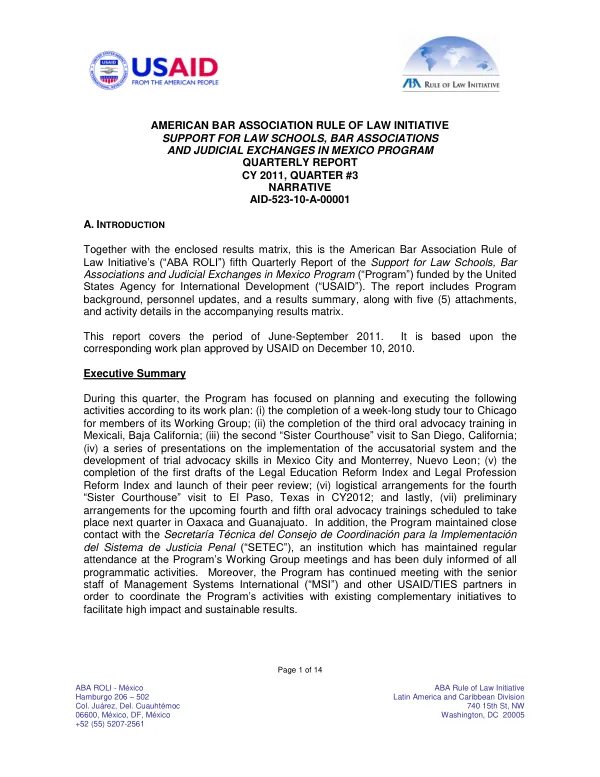
American Bar Association Rule of Law Initiative Support for Law Schools, Bar Associations and Judicial Exchanges in Mexico Program Quarterly Report CY 2011, Quarter #3
Sign inUSAID DEC
American Bar Association Rule of Law Initiative Support for Law Schools, Bar Associations and Judicial Exchanges in Mexico Program Quarterly Report CY 2011, Quarter #3
The American Bar Association Rule of Law Initiative's Support for Law Schools, Bar Associations and Judicial Exchanges in Mexico Program is a USAID-funded initiative aimed at promoting the transition to an accusatorial legal system in Mexico.
2011 · 14 pages
Sign in to readA free account is required to download.
Abstract
The program, which began in June 2010, focuses on creating a sustainable mechanism to alleviate the state and federal government burden of retraining current and future justice operators in the new system. The program's efforts are oriented towards supporting private and public justice sector members' understanding of the dynamics underlying the accusatorial system and their active engagement in the process. This is particularly important in light of the federal government's submission of a draft Federal Criminal Procedure Code to Congress in September 2011, which will serve as a model for many states that have not yet approved their own secondary legislation. The program supports the Mexican justice sector through various activities, including establishing a Working Group to promote local ownership of reforms and training, supporting bar associations and law schools, and conducting judicial exchanges. The Working Group, composed of members from various sectors, has demonstrated a high level of engagement with the program through their participation in various activities, including a week-long study tour to Chicago and the peer review of the first drafts of the Legal Education Reform and Legal Profession Reform Indices. The program has also maintained close contact with the Secretaría Técnica del Consejo de Coordinación para la Implementación del Sistema de Justicia Penal (SETEC) and has coordinated its activities with existing complementary initiatives to facilitate high-impact and sustainable results. The program's personnel, including Country Director Alonso González Villalobos and Deputy Country Director Katia Ornelas Núñez, have worked closely with the Working Group and other stakeholders to promote the program's objectives. During the reporting period, the program has made significant progress in promoting the transition to an accusatorial legal system in Mexico. The Working Group has demonstrated a high level of engagement with the program, and the program has maintained close contact with key stakeholders, including SETEC and the bar associations. The program's activities have also contributed to the development of the Legal Education Reform and Legal Profession Reform Indices, which will serve as a basis for recommendations for reform. The program's success is evident in the high level of engagement demonstrated by the Working Group and the program's ability to coordinate its activities with existing complementary initiatives. The program's efforts have also contributed to the development of a sustainable mechanism to alleviate the state and federal government burden of retraining current and future justice operators in the new system. The program's activities have also included supporting bar associations and law schools, conducting judicial exchanges, and awarding a follow-on subgrant to ensure program sustainability beyond the life of the program. The program's personnel have worked closely with the Working Group and other stakeholders to promote the program's objectives, and the program has maintained close contact with key stakeholders, including SETEC and the bar associations. The program's quarterly report highlights the progress made during the reporting period, including the completion of a week-long study tour to Chicago, the completion of the third oral advocacy training in Mexicali, and the second "Sister Courthouse" visit to San Diego, California. The report also highlights the program's efforts to promote the transition to an accusatorial legal system in Mexico, including the development of the Legal Education Reform and Legal Profession Reform Indices.
Related documents