USAID DEC
AmericasBarometer: Topical Brief – March 23, 2016
The warming of relations between Argentina and the United States has been a topic of interest in recent years.
2016 · 7 pages
Sign in to readA free account is required to download.
Abstract
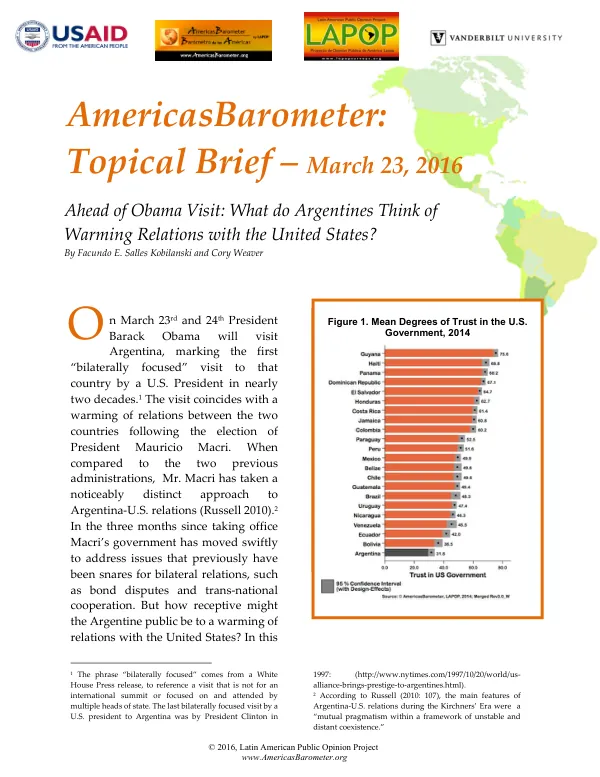
President Barack Obama's visit to Argentina in March 2016 marked a significant step in this process. The visit was the first "bilaterally focused" visit to Argentina by a U.S. President in nearly two decades. This development comes after the election of President Mauricio Macri, who has taken a distinct approach to Argentina-U.S. relations compared to his predecessors. Public attitudes in Argentina towards the U.S. government have been shaped by historical events, including the 1940s when President Perón maneuvered to confront U.S. hegemony in the region. Despite shifts in the nature of distrust, Argentine public opinion continues to reflect anti-U.S. sentiment. According to the 2012 and 2014 AmericasBarometer surveys, the average degree of trust in the U.S. government reported by Argentines is lower than that in any other country in the Latin America and Caribbean region. The data from the surveys show that Argentina ranks lower than other countries commonly portrayed as harboring anti-U.S. attitudes, such as Venezuela and Bolivia. The focus of President Obama's visit to Argentina was to increase trans-national cooperation in areas such as trade, investment, and citizen security. However, the data suggest that both Argentina and the U.S. will need to consider carefully the most effective ways to bring the Argentine public on board with this type of cooperation. A high-level delegation of security officials from the Macri administration met with U.S. counterparts in Washington D.C. in February 2016. The data from the 2014 AmericasBarometer survey of Argentina and an Ordinary Least Squares (OLS) model that regresses individuals' trust in the U.S. government on their socioeconomic, demographic, and certain attitudinal characteristics provide insights into the factors that influence trust in the U.S. government among the Argentine public. The results of the OLS model show that certain socioeconomic, demographic, and attitudinal characteristics are associated with higher levels of trust in the U.S. government. For example, individuals with higher levels of education and wealth tend to express more trust in the U.S. government. Additionally, individuals who agree with the statement that the Argentine government should own the most important enterprises and industries in the country tend to express lower levels of trust in the U.S. government. The data also suggest that underlying concerns among many in Argentina about the potential involvement of U.S. agencies like the CIA or DEA may be a factor in the low levels of trust in the U.S. government. The results of the OLS model provide a nuanced understanding of the factors that influence trust in the U.S. government among the Argentine public and highlight the need for careful consideration of the most effective ways to bring the Argentine public on board with trans-national cooperation.