USAID DEC
Campaigns and Voters in Developing Democracies: Argentina in Comparative Perspective
Sign inLAPOP – VANDERBILT UNIVERSITY
Campaigns and Voters in Developing Democracies: Argentina in Comparative Perspective
The book "Campaigns and Voters in Developing Democracies" focuses on understanding voting behavior in developing democracies, which differ significantly from advanced democracies.
2019 · 304 pages
Sign in to readA free account is required to download.
Abstract
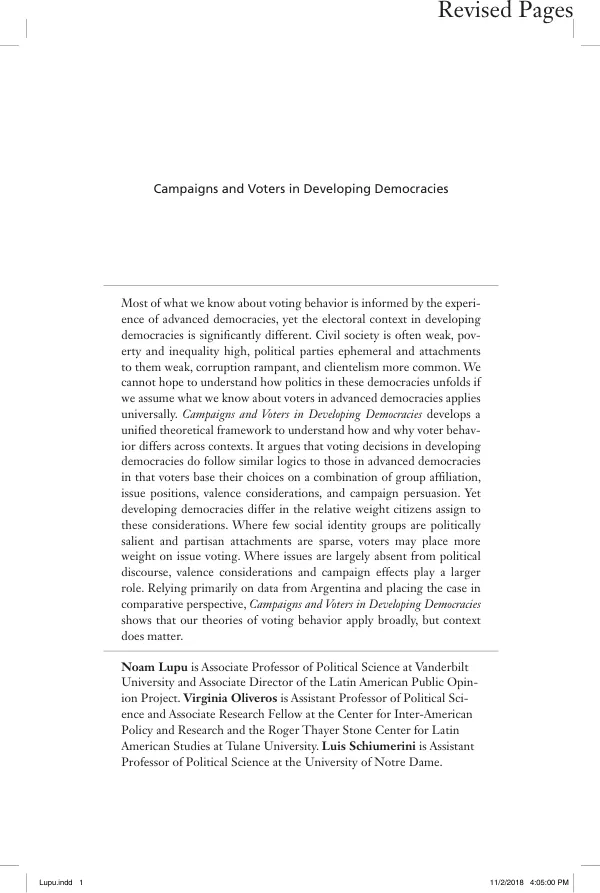
Civil society is often weak, poverty and inequality are high, and political parties are ephemeral and lack strong attachments. The book develops a unified theoretical framework to explain how and why voter behavior differs across contexts. Voting decisions in developing democracies are based on a combination of group affiliation, issue positions, valence considerations, and campaign persuasion. However, the relative weight citizens assign to these considerations varies across contexts. In contexts where few social identity groups are politically salient and partisan attachments are sparse, voters may place more weight on issue voting. Conversely, where issues are largely absent from political discourse, valence considerations and campaign effects play a larger role. The book relies primarily on data from Argentina and places the case in comparative perspective. It shows that theories of voting behavior apply broadly, but context does matter. The authors argue that understanding how politics unfolds in developing democracies requires considering the unique characteristics of these contexts. The book is edited by Noam Lupu, Virginia Oliveros, and Luis Schiumerini, and it is part of the Weiser Center for Emerging Democracies series, which publishes cutting-edge research in authoritarianism and democratization studies. The series aims to collect a balance of titles on emerging democracies and enduring dictatorships, and it encompasses a global geographic reach. The book is divided into 11 chapters, each focusing on a different aspect of voting behavior in developing democracies. The chapters cover topics such as economic shocks and partisan realignment, down-to-the-wire campaigns, and the impact of wealth on vote choice. The book also explores the role of mass partisanship, support for the incumbent, and the effects of campaign persuasion on voting behavior. The research for the book was conducted through a panel election study in Argentina, which was designed and fielded by a team of researchers from the University of Wisconsin and Vanderbilt University. The study was supported by the Elections Research Center and the Latin American, Caribbean and Iberian Studies Program at UW. The edited volume emerged as a natural outgrowth of the intellectual energy surrounding the work on the 2015 Argentine Panel Election Study. The book brings together an all-star team of colleagues whose research interests span the field, from economic voting to partisanship to clientelism. The authors held two workshops to discuss findings, present draft chapters, and draw broader implications. The book is a significant contribution to comparative political behavior and provides insights into the complexities of voting behavior in developing democracies.