JOHNS HOPKINS UNIVERSITY
An HC3 Research Primer: Ideation
Ideation refers to the process by which new ways of thinking or behaviors are diffused through a community through communication and social interaction among individuals and groups.
2014 · 2 pages
Sign in to readA free account is required to download.
Abstract
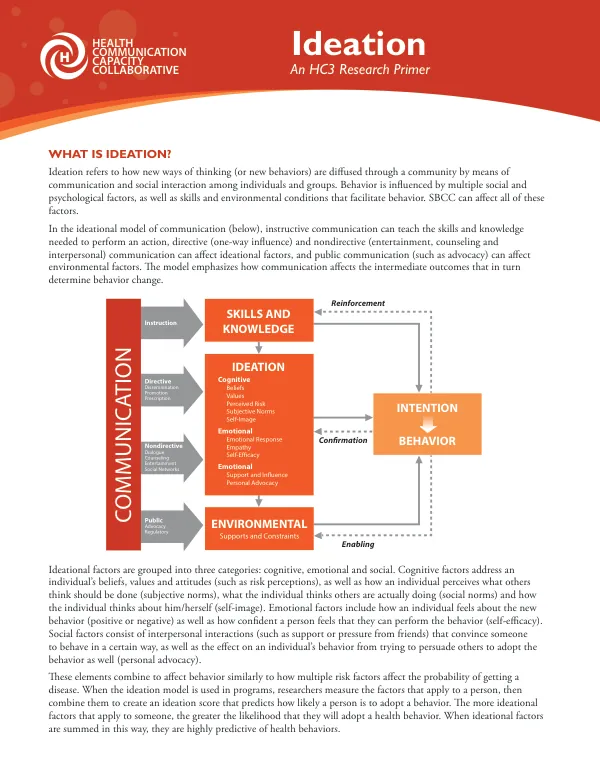
This process is influenced by multiple social and psychological factors, as well as skills and environmental conditions that facilitate behavior. Social and Behavioral Change Communication (SBCC) can affect all of these factors. The ideational model of communication emphasizes how communication affects intermediate outcomes that in turn determine behavior change. Ideational factors are grouped into three categories: cognitive, emotional, and social. Cognitive factors address an individual's beliefs, values, and attitudes, as well as how an individual perceives what others think should be done, what the individual thinks others are actually doing, and how the individual thinks about him or herself. Emotional factors include how an individual feels about the new behavior and how confident a person feels that they can perform the behavior. Social factors consist of interpersonal interactions that convince someone to behave in a certain way, as well as the effect on an individual's behavior from trying to persuade others to adopt the behavior. When the ideation model is used in programs, researchers measure the factors that apply to a person, then combine them to create an ideation score that predicts how likely a person is to adopt a behavior. The more ideational factors that apply to someone, the greater the likelihood that they will adopt a health behavior. When ideational factors are summed in this way, they are highly predictive of health behaviors. Ideation should be used when trying to identify the psychosocial factors that predict behavior or when trying to causally attribute behavior change to communication interventions. By creating a combined ideational index, researchers can show that individuals who have more ideational factors are more likely to adopt a given behavior. The likelihood of someone adopting and sustaining a new behavior is much higher when they have gained sufficient knowledge about it, have developed a positive attitude towards it, think others support and practice it, have talked to others about it, and feel good about doing it. SBCC research has found that although the specific ideation factors that operate in a given country will vary, culturally adapted ideation scales can be developed and used to design and evaluate programs in many different settings and for many different behavioral outcomes. Research has also found specific factors that apply across cultures. The ideation approach has been used to assess behavioral impact of family planning, female genital cutting, youth reproductive health, HIV/AIDS, avian influenza, and household water treatment and hygiene programs. The Nigerian Urban Reproductive Health Initiative (NURHI) began in 2009 with the goal of significantly increasing the use of modern contraception among urban poor in six cities in Nigeria. Interventions included the integration of family planning services with other health services, improving the quality of family planning services in high-volume settings, creating demand and encouraging sustained use of contraceptives, and increasing funding and supportive environments at the policy level to ensure access to family planning in urban poor areas. At the project's mid-term assessment in 2012, data were collected on overall contraceptive use among married women or women living with a partner. Significant increases were seen between baseline and mid-term in the percentage of women who knew of modern family planning methods and intended to use them in the near future. Ideation scores were also calculated at baseline and mid-term. Among women with more exposure to the NURHI campaign, ideation scores were 13% higher than among women with zero exposure. Women exposed to the NURHI program were more likely to have higher ideational factors, and women with higher ideational factors were more likely to use contraceptives. These cognitive, emotional, and social factors that influence contraceptive use included perceptions of social norms about family planning, knowledge, attitudes, and beliefs about family planning, and self-efficacy for using contraception.