USAID DEC
Transitioning from International Funding to Domestic Health Financing to Support Key Population-Led Health Services in Thailand: The Songkhla Model
Sign inFHI 360
Transitioning from International Funding to Domestic Health Financing to Support Key Population-Led Health Services in Thailand: The Songkhla Model
The key population-led health services (KPLHS) model has proven to be a crucial strategy for ending HIV in Thailand.
2019 · 2 pages
Sign in to readA free account is required to download.
Abstract
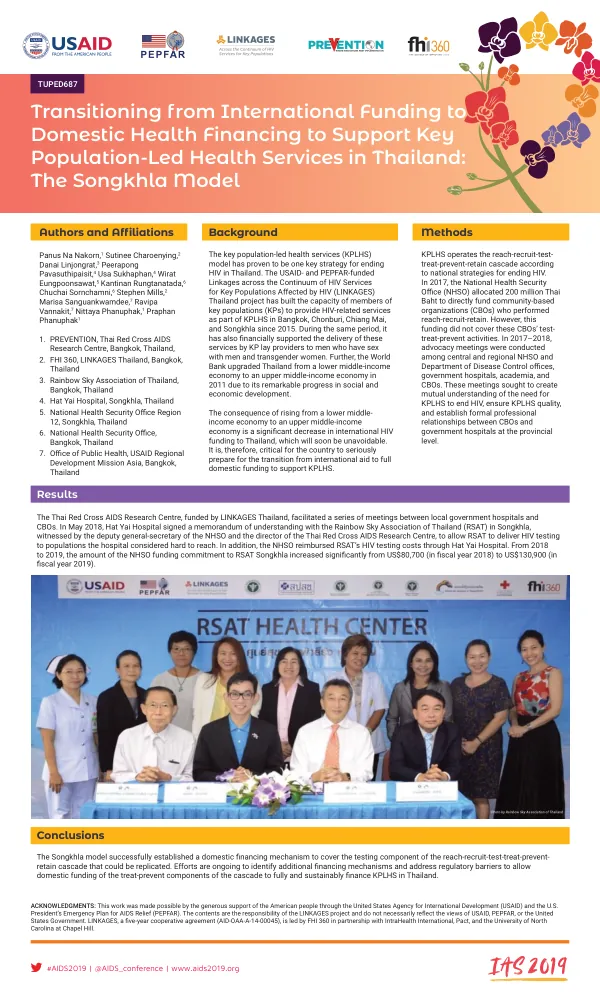
This model has been implemented in various provinces, including Bangkok, Chonburi, Chiang Mai, and Songkhla, since 2015. The USAID- and PEPFAR-funded Linkages across the Continuum of HIV Services for Key Populations Affected by HIV (LINKAGES) Thailand project has built the capacity of members of key populations (KPs) to provide HIV-related services as part of KPLHS. The KPLHS model operates the reach-recruit-test-treat-prevent-retain cascade according to national strategies for ending HIV. In 2017, the National Health Security Office (NHSO) allocated 200 million Thai Baht to directly fund community-based organizations (CBOs) who performed reach-recruit-retain. However, this funding did not cover these CBOs' test-treat-prevent activities. To address this gap, advocacy meetings were conducted among central and regional NHSO and Department of Disease Control offices, government hospitals, academia, and CBOs. These meetings aimed to create mutual understanding of the need for KPLHS to end HIV, ensure KPLHS quality, and establish formal professional relationships between CBOs and government hospitals at the provincial level. In Songkhla, a domestic financing mechanism was established to cover the testing component of the reach-recruit-test-treat-prevent-retain cascade. In May 2018, Hat Yai Hospital signed a memorandum of understanding with the Rainbow Sky Association of Thailand (RSAT) to allow RSAT to deliver HIV testing to populations the hospital considered hard to reach. The National Health Security Office (NHSO) reimbursed RSAT's HIV testing costs through Hat Yai Hospital. From 2018 to 2019, the amount of the NHSO funding commitment to RSAT Songkhla increased significantly from US$80,700 to US$130,900. The Songkhla model successfully established a domestic financing mechanism to cover the testing component of the reach-recruit-test-treat-prevent-retain cascade. Efforts are ongoing to identify additional financing mechanisms and address regulatory barriers to allow domestic funding of the treat-prevent components of the cascade to fully and sustainably finance KPLHS in Thailand. The transition from international aid to full domestic funding is critical for the country to sustainably finance KPLHS and end HIV in Thailand. The World Bank upgraded Thailand from a lower middle-income economy to an upper middle-income economy in 2011 due to its remarkable progress in social and economic development. As a result, international HIV funding to Thailand will soon be unavoidable. It is essential for the country to prepare for this transition and establish a sustainable domestic financing mechanism to support KPLHS. The success of the Songkhla model demonstrates the potential for domestic financing to support KPLHS and end HIV in Thailand.