TETRA TECH
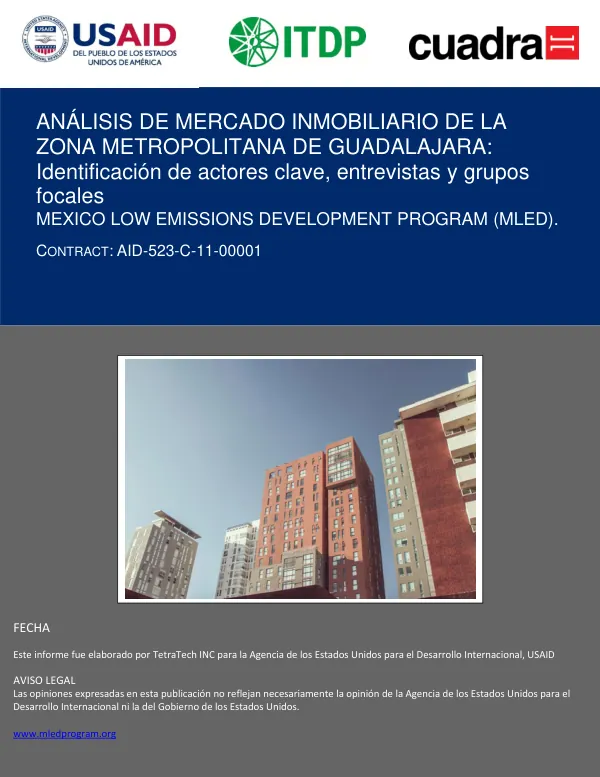
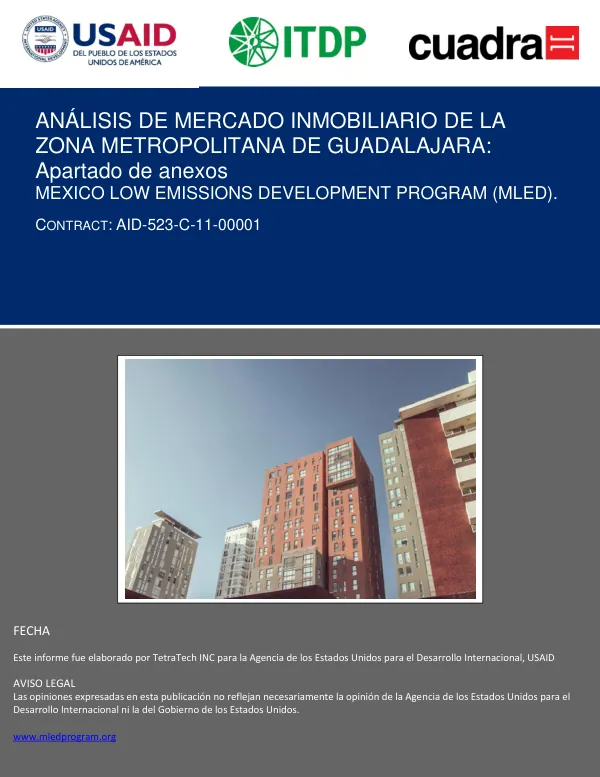
Análisis de Mercado Inmobiliario de la Zona Metropolitana de Guadalajara
The study on the real estate market in the Guadalajara metropolitan area was conducted by ITDP, with Alonso Rizo as the principal author, under the supervision of Cynthia Menéndez and Ricardo Troncoso from WWF Mexico, as part of the Mexico Low Emissions Development Program (MLED) sponsored by the United States Agency for International Development (USAID) under contract AID-523-C-11-00001 implemented by Tetra Tech ES Inc.
2016 · 90 pages
Sign in to readA free account is required to download.
Abstract
The study aimed to analyze the real estate market in the Guadalajara metropolitan area, identifying key actors, market trends, and challenges. The research involved a comprehensive review of existing literature, as well as interviews with key stakeholders, including developers, government officials, and experts in the field. The study identified several key actors in the Guadalajara real estate market, including government agencies, private developers, and non-profit organizations. The government agencies involved in the study included the Consejo Estatal de Desarrollo Urbano, the Sistema de Tren Eléctrico Urbano, and the Instituto Jalisciense de la Vivienda, among others. The study also identified several key market trends in the Guadalajara real estate market, including a shift towards vertical development, increased demand for housing near public transportation, and a growing need for affordable housing. The study found that the Guadalajara real estate market is characterized by a lack of affordable housing options, particularly in the eastern part of the city. The study recommended several policy interventions to address the challenges facing the Guadalajara real estate market, including the promotion of vertical development, the creation of affordable housing options, and the improvement of public transportation infrastructure. The study also recommended the development of a comprehensive urban planning strategy to guide the growth and development of the Guadalajara metropolitan area. The study's findings and recommendations are based on a comprehensive review of existing literature and data, as well as interviews with key stakeholders in the Guadalajara real estate market. The study provides a detailed analysis of the market trends, challenges, and opportunities facing the Guadalajara real estate market, and offers a range of policy interventions to address these challenges. The study's methodology involved a comprehensive review of existing literature and data, as well as interviews with key stakeholders in the Guadalajara real estate market. The study's data collection methods included surveys, interviews, and focus groups with developers, government officials, and experts in the field. The study's results are presented in a clear and concise manner, with a focus on the key findings and recommendations. The study's conclusions are based on a thorough analysis of the data and literature review, and provide a comprehensive understanding of the Guadalajara real estate market. The study's policy recommendations are based on a thorough analysis of the market trends, challenges, and opportunities facing the Guadalajara real estate market. The study recommends several policy interventions to address the challenges facing the market, including the promotion of vertical development, the creation of affordable housing options, and the improvement of public transportation infrastructure. The study's findings and recommendations are relevant to policymakers, developers, and other stakeholders in the Guadalajara real estate market. The study provides a comprehensive understanding of the market trends, challenges, and opportunities facing the Guadalajara real estate market, and offers a range of policy interventions to address these challenges.