USAID
Competitiveness Program: Scenarios of Energy Demand and Economic Growth
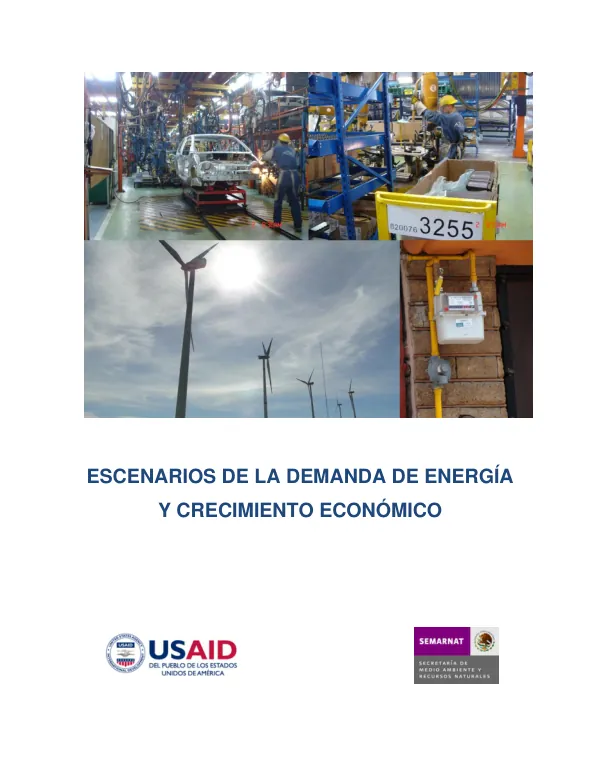
The competitiveness program for energy demand and economic growth in Mexico is a study that aims to analyze and construct the trajectories of total energy demand and sectoral demand for Mexico from 2010 to 2050, consistent with the growth of economic activities in the next four decades.
2012 · 132 pages
Sign in to readA free account is required to download.
Abstract
The methodology used is based on the specification and estimation of econometric models on energy demand, assuming the main explanatory variables to be the level of economic activity and relative energy prices. These models allow for simulation and projection exercises on energy consumption, considering different scenarios on relative prices and economic growth. The study focuses on three sectors: transportation, industries, and industry, which account for 24%, 28%, and 17.4% of total energy demand, respectively. These sectors have registered a sustained growth in energy consumption over the past seven years, leading to an increase in greenhouse gas emissions. The results of the econometric models show that there are long-term relationships between energy demand by sector, national and sectoral product, and relative energy prices. The income elasticities are positive and average values are less than one, while the price elasticities are negative but close to zero. The study concludes that energy demand in Mexico shows a strong dependence and association between energy consumption and product, with movements in prices not influencing its long-term trajectory. The sources of energy supply are based on fossil fuels, mainly natural gas, fuel oil, gasoline, and diesel, which means that if these sources are not modified, the increasing energy demand in the future will lead to an increase in the demand for these fuels. Under a base scenario where the economy grows at an average annual rate of 3% between 2010 and 2050, national energy consumption is expected to grow at an annual rate of 2.81%. The study highlights the importance of considering the impact of energy demand on greenhouse gas emissions and the need to develop a strategy to reduce emissions. The study also emphasizes the need to consider the costs associated with climate change, which could be significant, and to develop policies to mitigate these costs. The study concludes that the competitiveness program for energy demand and economic growth in Mexico should aim to reduce energy demand and greenhouse gas emissions, while promoting economic growth and development. The study also discusses the impact of climate change on the economy, highlighting the potential costs of climate change, which could be significant. The study cites the Stern Report, which estimates that the costs of climate change could be up to 20% of global GDP per year. The study also mentions the study of meta-analysis by Tol, which relates changes in temperature levels and the costs of climate change in different regions of the world. The study concludes that there is a consensus on the trend of increasing costs expected with an increase in greenhouse gas concentrations. The study also discusses the importance of considering the impact of climate change on different sectors of the economy, including agriculture, forestry, and fisheries. The study highlights the potential impacts of climate change on these sectors, including changes in temperature and precipitation patterns, sea-level rise, and increased frequency and severity of extreme weather events. The study concludes that the competitiveness program for energy demand and economic growth in Mexico should aim to reduce the vulnerability of these sectors to climate change. In conclusion, the competitiveness program for energy demand and economic growth in Mexico is a study that aims to analyze and construct the trajectories of total energy demand and sectoral demand for Mexico from 2010 to 2050, consistent with the growth of economic activities in the next four decades. The study highlights the importance of considering the impact of energy demand on greenhouse gas emissions and the need to develop a strategy to reduce emissions. The study also emphasizes the need to consider the costs associated with climate change, which could be significant, and to develop policies to mitigate these costs.