USAID DEC
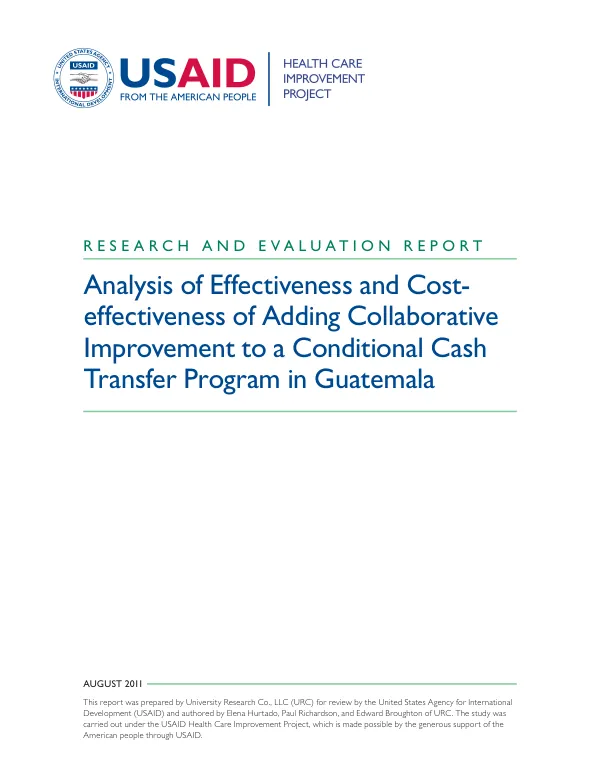
Analysis of Effectiveness and Cost-effectiveness of Adding Collaborative Improvement to a Conditional Cash Transfer Program in Guatemala
Sign inENCOMPASS, LLC
Analysis of Effectiveness and Cost-effectiveness of Adding Collaborative Improvement to a Conditional Cash Transfer Program in Guatemala
The USAID Health Care Improvement Project conducted a research and evaluation report in Guatemala to analyze the effectiveness and cost-effectiveness of adding collaborative improvement to a conditional cash transfer program.
2011 · 36 pages
Sign in to readA free account is required to download.
Abstract
The study was carried out by University Research Co., LLC (URC) and supported by the American people through the United States Agency for International Development (USAID). The conditional cash transfer program in Guatemala aimed to improve maternal and child health care services by providing cash transfers to beneficiaries who utilized these services. The program was implemented in various health facilities across the country, including centro de atención médica permanente (CAP), centro de atención integral materno-infantil (CAIMI), and centro de atención a pacientes ambulatorios (CENAPA). The study found that the addition of collaborative improvement to the conditional cash transfer program resulted in improved compliance with maternal and child health care technical norms. Specifically, the study found that collaborative health centers had higher compliance rates with quality prenatal care criteria, quality preventive child care criteria, and essential obstetric and newborn care (EONC) criteria compared to non-collaborative health centers. The cost-effectiveness analysis of adding collaborative improvement to the conditional cash transfer program revealed that the incremental cost-effectiveness ratio (ICER) was $0.35 per dollar spent on collaborative improvement. This indicates that for every dollar spent on collaborative improvement, there was a cost savings of $0.35. The study also found that the cost per service for collaborative sites was lower compared to non-collaborative sites. The study concluded that adding collaborative improvement to the conditional cash transfer program in Guatemala was a cost-effective strategy for improving maternal and child health care services. The study recommended that the program be scaled up to reach more beneficiaries and that the collaborative improvement approach be integrated into the program's design and implementation. The study's findings have implications for the design and implementation of conditional cash transfer programs in other countries. The study suggests that adding collaborative improvement to these programs can lead to improved health outcomes and cost savings. The study's results also highlight the importance of integrating quality improvement approaches into health care programs to improve the quality of care provided to beneficiaries. The study's methodology involved a research model that included a cost-effectiveness analysis and an analysis of compliance with maternal and child health care technical norms. The study used data from a sample of health facilities in Guatemala and controlled for confounders to ensure the accuracy of the results. The study's results are relevant to policymakers, program managers, and health care providers who are interested in improving maternal and child health care services in low- and middle-income countries. The study's findings provide evidence for the effectiveness and cost-effectiveness of adding collaborative improvement to conditional cash transfer programs and highlight the importance of integrating quality improvement approaches into health care programs.