USAID DEC
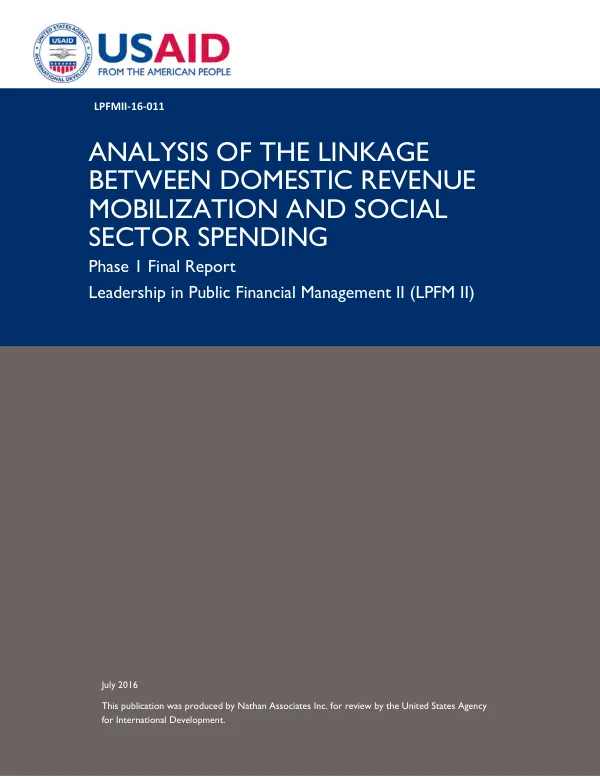
Analysis of the Linkage Between Domestic Revenue Mobilization and Social Sector Spending
Sign inROBERT NATHAN ASSOCIATES
Analysis of the Linkage Between Domestic Revenue Mobilization and Social Sector Spending
Domestic Revenue Mobilization and Social Sector Spending The Sustainable Development Goals (SDGs) emphasize the importance of strengthening domestic resource mobilization, including through international support to developing countries, to improve capacity for tax and other revenue collection.
2016 · 40 pages
Sign in to readA free account is required to download.
Abstract
Low-income countries are able to mobilize only 13 percent of their Gross Domestic Product (GDP) on average, compared to the 20 percent of GDP that the United Nations estimates would be required to achieve the SDGs. Developing countries face increasing pressures to increase public service delivery, particularly for priority sectors such as health and education. The study aims to investigate whether a linkage exists between domestic resources and public expenditure in health. Specifically, it aims to quantify the relationship between domestic resources and public expenditure in health, and identify possible reasons for why such observed differences exist across countries, including levels of external health financing, governance factors, and demographics. The study uses government tax revenue as a proxy for domestic resources and analyzes how it influences government expenditure in the health sector. The analysis is conducted for three income groups: low-income, lower-middle-income, and higher-middle-income countries, based on the World Bank country classifications using GNI per capita. The study uses country-level time series data publicly available from sources such as the World Development Indicators (WDI), International Monetary Fund (IMF), World Health Organization (WHO), and other international sources. The analysis finds that when normalized for GDP, increased tax revenues lead to greater public expenditure on health in countries for all income groups. The study estimates that a 10 percent increase in national tax revenue leads to a 17 percent increase in public health expenditure in low-income countries, compared to a 4 percent and a 3 percent increase in lower-middle-income and higher-middle-income countries, respectively. The study's findings have implications for public policy agendas, particularly for creating fiscal space for priority social sectors such as health and education. The study suggests that increased government revenues can result in greater budget allocations to the health sector, which could motivate health departments/ministries to actively support DRM initiatives as well as increase ODA allocations to tax-related support. The study's empirical analysis is based on a literature review of factors influencing government spending on health and education. The analysis uses a regression model to examine the relationship between government expenditure in health and tax revenues, while accounting for factors such as GDP per capita, external assistance for health, population most in need of such services, and a country's international governance ratings. The study's results are significant because they provide evidence that increased domestic resources can lead to greater public expenditure on health, which is a critical component of achieving the SDGs. The study's findings have implications for policymakers, particularly in developing countries, who are seeking to strengthen their domestic resource mobilization efforts to achieve the SDGs. The study's limitations are discussed in the final section, which highlights areas for further research. The study's findings are based on a 25-year time series data from 74 countries, which may not capture the complexities of the relationship between domestic resources and public expenditure in health. Further research is needed to explore the relationship between domestic resources and public expenditure in health in more detail, particularly in the context of specific countries and regions.
Related documents