ENCOMPASS, LLC
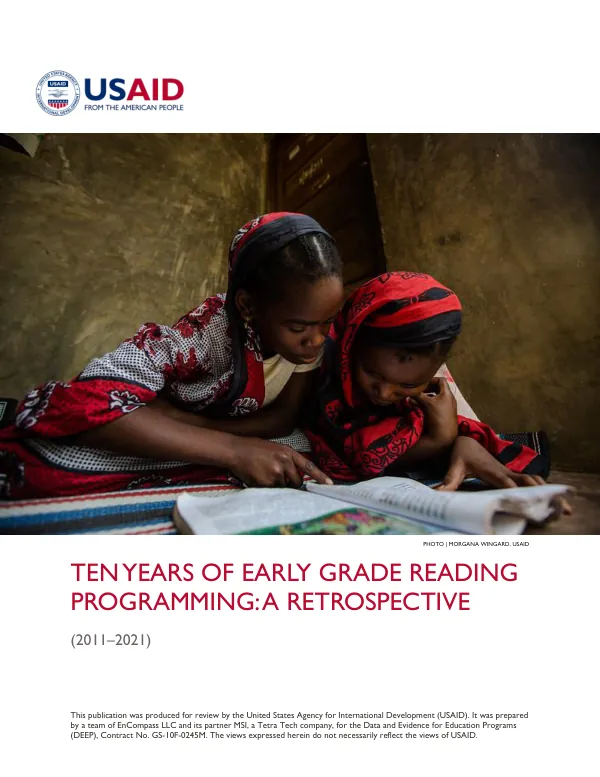
10 Years of Early Grade Reading Programming: A Retrospective (2011–2021)
Early grade reading (EGR) programming has been a key focus for the United States Agency for International Development (USAID) over the past decade.
2021 · 30 pages
Sign in to readA free account is required to download.
Abstract
With the release of the 2011 USAID Education Strategy, USAID shifted global attention to the importance of early grade reading, particularly the quality of reading instruction. To support this focus, USAID funded early grade reading assessments (EGRA) to highlight the magnitude of the challenge and use data and evidence to facilitate discussions around the urgent need for reform. Since 2011, USAID EGR programming has benefited an estimated 246 million students, as well as millions of teachers and administrators in 53 countries. USAID programs have designed, produced, and distributed countless teaching and learning materials needed to support quality instructional practice. Additional achievements include generating data that provide insight into student learning and increase the focus on the quality of schooling in early grades, building the evidence base for effective approaches to literacy acquisition and instruction, especially in multilingual contexts, promoting equity in learning, particularly for the most marginalized, and promoting policies that support children learning to read in a language they understand. Analysis of USAID programming from 2011 to 2021 indicates that EGR programming is becoming more effective, with second-generation programs tending to reach a larger number of beneficiaries, improving reading among a larger percentage of students, and having a lower average cost per beneficiary and per improved reader. The core elements in reading programs evolved from Generations 1 to 2, including closer collaboration with partner-country governments and greater integration of programs in existing systems, increased levels of available expertise in reading instruction, expanded use of research-based approaches in reading instruction and in the development of teaching and learning materials, more common use of language analysis and mapping, more effective teacher training approaches, and more systematic collection and use of monitoring data. These improvements have not been experienced universally, and many countries continue to struggle to ensure quality learning for all children. When improvements fell short of expectations, it was often in areas impacted by conflict and crisis and without strong support from partner governments. Conversely, even in complex environments, USAID programs made significant increases in learning outcomes when they built on the success of multigenerational programs, utilized existing systems, and worked in partnership with governments to ensure sustainability. To support meaningful reform, EGR programs must reflect a deep understanding of the local context, be based on close collaboration with partner-country governments, and apply evidence-based reading instruction approaches adapted to reflect existing capacity and systems. The time needed to integrate these elements into programs and the time needed for teaching staff, administrators, and ministries to adopt new behaviors is frequently at odds with EGR programs' short-term student learning outcome targets. Reflecting on lessons gleaned from organizations implementing early grade reading programs, the following top-level recommendations for EGR programming are drawn. First, build in time and resources needed to design and develop programs based on country context. Incorporate an inception phase or extend the period of performance on EGR programming to allow time for new programs to thoroughly research the country context and to work closely with partner-country governments and stakeholders on program design and implementation. Second, build flexibility into program design to maximize effectiveness. Build flexibility into program design and contract/agreement structures to accommodate design and implementation adjustments needed to maximize effectiveness. Third, utilize research-based approaches. Encourage adherence to best practices in reading materials and instruction so that all programs benefit from research-based approaches. Fourth, strengthen sustainability and use of data systems. Promote ongoing and sustained monitoring of progress through sustainable data systems and the identification of strengths as well as areas for improvement. Fifth, make programming more equitable. Design programming in ways that engage and benefit the most marginalized. Sixth, build resilience into program design. Integrate resilience into program design by developing effective and equitable distance and other alternative learning approaches to mitigate learning loss in times of crisis. Finally, develop system indicators. Measure system strengthening to both encourage and capture system-level program impacts that can frequently be detected before significant student learning gains become discernible. While much progress has been made over the last decade, COVID-19 has undermined improvements in school attendance and literacy rates, especially among the most marginalized learners. Addressing the learning crisis will take time and require focused, sustained, and substantial efforts. Incorporating lessons learned from the past ten years of USAID EGR programs will help USAID's efforts to support partner governments as they design and implement reforms to address the current global education crisis.
Related documents