USAID DEC
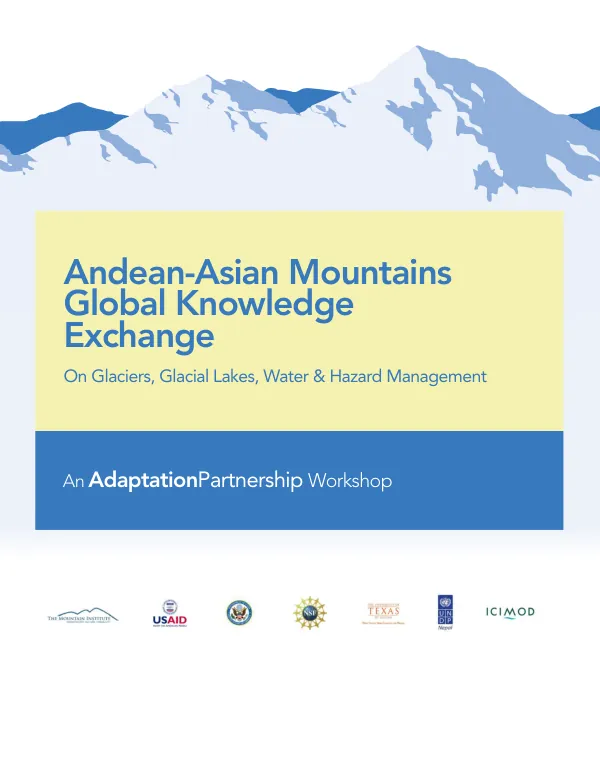
Andean Asian Mountains Global Knowledge Exchange: On Glaciers, Glacial Lakes, Water & Hazard Management
Sign inIRG
Andean Asian Mountains Global Knowledge Exchange: On Glaciers, Glacial Lakes, Water & Hazard Management
The 2011 Andean-Asian Glacial Lake Expedition was a collaborative effort between The Mountain Institute and its partners, including the National Science Foundation, USAID, IRG, and other organizations.
2012 · 235 pages
Sign in to readA free account is required to download.
Abstract
The expedition aimed to replicate and expand upon the Peruvian work on climate change impacts in the Hindu Kush-Himalaya (HKH) region, promoting South-South collaboration and exchange. The expedition brought together over 35 high-altitude professionals from 15 countries, including physical and social scientists from the Andes, Hindu Kush-Himalaya, Central Asia, Japan, North America, and Europe. The expedition focused on the remote region of eastern Nepal, where participants spent 18 days conducting research and gathering data. The active participation of local people was a key aspect of the expedition, marking the first time in 30 years of research at Imja Lake that local people were involved in the research process. The expedition aimed to identify new, potential triggers to a glacial lake outburst flood that had gone unnoticed by previous studies. During the expedition, ideas for new, practical solutions to the growing threat of glacial lake outburst floods (GLOFs) were discussed in detail. The emphasis was on the involvement of local people in all phases of future applied research, risk assessments, and remedial solutions. The expedition provided a unique opportunity for international collaboration and knowledge sharing, with a focus on addressing the challenges posed by climate change in the HKH region. The expedition was followed by a four-day workshop hosted by the International Centre for Integrated Mountain Development (ICIMOD) in Kathmandu, Nepal. The workshop brought together expedition members and additional participants to discuss the findings and implications of the expedition. The workshop provided a platform for knowledge sharing and collaboration, with a focus on developing practical solutions to the threat of GLOFs. The Hindu Kush-Himalaya (HKH) region is particularly vulnerable to the impacts of climate change, with many glaciers melting and creating new glacier lakes. These lakes pose a significant risk of glacial lake outburst floods (GLOFs), which can cause devastating downstream effects, including loss of life, damage to infrastructure, and destruction of farmland. The 2011 Andean-Asian Glacial Lake Expedition aimed to address this challenge by promoting international collaboration and knowledge sharing, with a focus on developing practical solutions to the threat of GLOFs. The expedition and workshop were significant events in the field of glaciology and climate change research, bringing together international experts and local stakeholders to address the challenges posed by climate change in the HKH region. The collaboration and knowledge sharing facilitated by the expedition and workshop have the potential to inform policy and decision-making, ultimately contributing to the development of effective strategies for mitigating the impacts of climate change in the region. The expedition and workshop also highlighted the importance of involving local people in the research process, particularly in the context of climate change research. The active participation of local people in the expedition and workshop provided valuable insights and perspectives, underscoring the need for inclusive and participatory approaches to addressing the challenges posed by climate change. The 2011 Andean-Asian Glacial Lake Expedition and the subsequent workshop marked an important milestone in the field of glaciology and climate change research, demonstrating the potential for international collaboration and knowledge sharing to inform policy and decision-making. The expedition and workshop have contributed to a deeper understanding of the challenges posed by climate change in the HKH region, highlighting the need for continued research and collaboration to develop effective strategies for mitigating the impacts of climate change.
Related documents