MINISTRY OF HEALTH
ANEP's STI/ HIV/ AIDS Workplace Policy
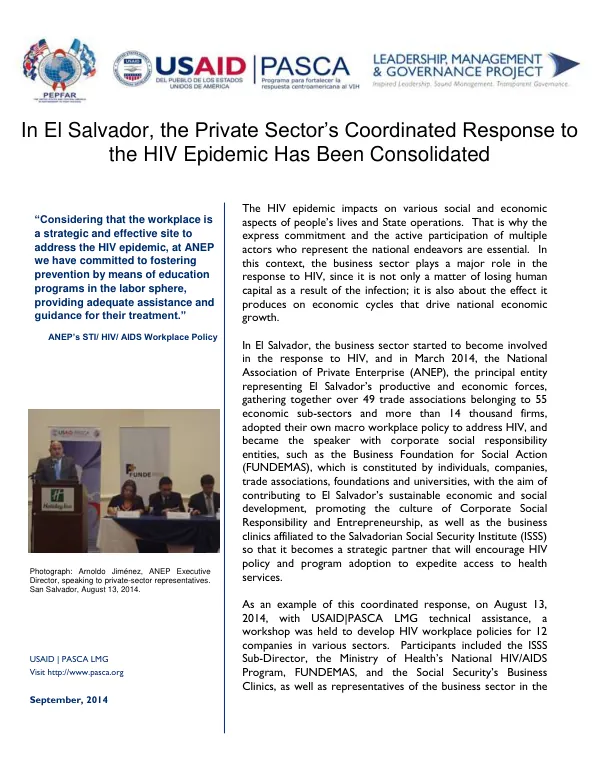
The National Association of Private Enterprise (ANEP) in El Salvador has committed to addressing the HIV epidemic through education programs, adequate assistance, and guidance for treatment in the labor sphere.
2014 · 2 pages
Sign in to readA free account is required to download.
Abstract
This commitment is part of ANEP's STI/HIV/AIDS Workplace Policy, which aims to foster prevention and mitigate the impact of the epidemic on the workforce and national economic growth. The business sector plays a significant role in the response to HIV, as it not only loses human capital due to infection but also experiences economic cycles that affect national economic growth. In March 2014, ANEP, representing over 49 trade associations and 14,000 firms, adopted a macro workplace policy to address HIV. This policy is a strategic partnership with corporate social responsibility entities, such as the Business Foundation for Social Action (FUNDEMAS), and the business clinics affiliated with the Salvadorian Social Security Institute (ISSS). As part of this coordinated response, a workshop was held on August 13, 2014, with technical assistance from USAID|PASCA LMG. The workshop aimed to develop HIV workplace policies for 12 companies in various sectors, including representatives from the ISSS, Ministry of Health, FUNDEMAS, and the Social Security's Business Clinics. Participants were informed about the HIV epidemic, its impact on the labor sphere, and the importance of involving the sector in the national HIV response. Each company defined the contents of its HIV policy, joining the 32 national firms that have already approved their policies. These companies have become active agents in strengthening public-private relations in the response to HIV. The adoption of HIV workplace policies by these companies is a significant step towards mitigating the impact of the epidemic on the workforce and promoting a culture of corporate social responsibility and entrepreneurship. The implementation of HIV workplace policies is a strategic and effective site to address the HIV epidemic, as it provides a framework for prevention, education, and treatment. By fostering a culture of corporate social responsibility and entrepreneurship, these policies can contribute to El Salvador's sustainable economic and social development.
Related documents