USAID DEC
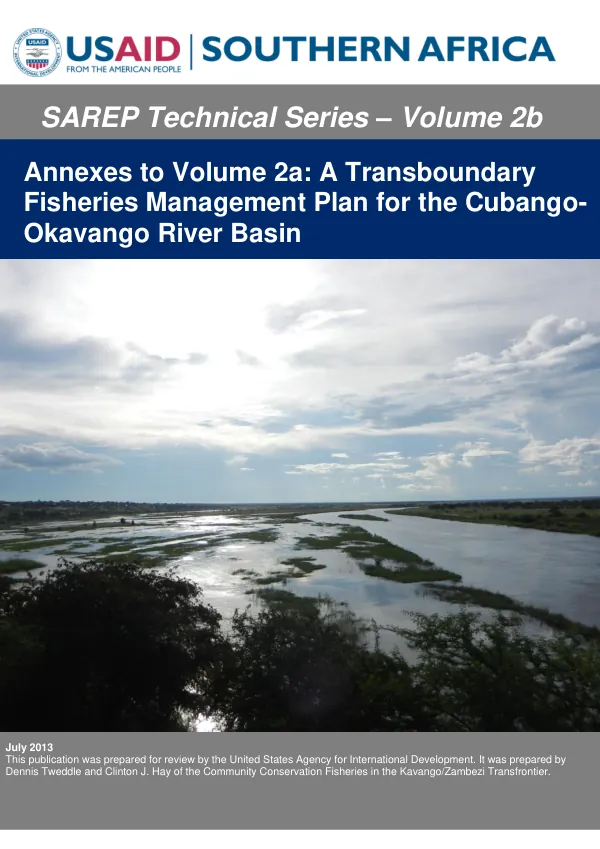
Annexes to Volume 2a: A Transboundary Fisheries Management Plan for the Cubango-Okavango River Basin
Sign inUSAID
Annexes to Volume 2a: A Transboundary Fisheries Management Plan for the Cubango-Okavango River Basin
The legislative and institutional framework for management of the Okavango Delta fisheries in Botswana is governed by several key pieces of legislation and policies.
2013 · 52 pages
Sign in to readA free account is required to download.
Abstract
The Fish Protection Act (Act 42 of 1975) provides the overarching framework for fisheries management, empowering the minister to make regulations and set fishing seasons, licensing and registration conditions, and fee structures. The act also prohibits the use of poisonous or explosive substances in the fishery and provides powers of entry, seizure, and arrest. The Fisheries Regulations (2008) are the first set of regulations developed to regulate fisheries in Botswana, providing a licensing framework for commercial gill net fishers, recreational fishers, and gill net importers and distributors. However, the regulations maintain the fishery as an open access fishery, with no restrictions on the number of entrants into the commercial or recreational fisheries. The Community-Based Natural Resources Management (CBNRM) Policy aims to engage communities in natural resource conservation by providing them with a framework to earn tangible benefits from sustainable natural resource management. Although fisheries are not explicitly mentioned in the policy, it provides useful insight into how communities could access and manage their local resources, including the establishment of community-based organizations (CBOs) to control access and enforce exclusion. The Draft Wildlife Policy is designed to provide a framework for conservation, sustainable resource use, and management of wildlife and biodiversity resources in the country. The policy focuses on generating development benefits for communities and provides a framework for co-management of natural resources, including fisheries. The institutional framework for fisheries management in Botswana is comprised of national institutions, local institutions in the delta, and international institutions/transboundary initiatives. National institutions include the Department of Wildlife and National Parks (DWNP), which is responsible for the management of wildlife and natural resources, including fisheries. Local institutions in the delta include community-based organizations (CBOs) and traditional authorities, which play a crucial role in the management of natural resources. The Kavango Open Africa Route (KOAR) has submitted concerns regarding tourism activities in the Okavango/Cubango River system, highlighting the need for harmonization of fishing activities to prevent conflict between recreational and commercial fishers. The submission emphasizes the importance of establishing clear user rights and regulations to prevent marginalization of certain stakeholders. A logical framework for the implementation of the transboundary fisheries management plan has been proposed, outlining the key components and activities required for the successful implementation of the plan. The framework includes the establishment of a transboundary management committee, the development of a fisheries management plan, and the implementation of research and monitoring activities. The proposed forms to be used in the implementation of research and monitoring activities have been outlined, including forms for data collection, reporting, and evaluation. The forms are designed to facilitate the collection of accurate and reliable data, which will be used to inform the management of the fishery and ensure the sustainability of the resource.