FOOD AND AGRICULTURE ORGANIZATION OF THE UNITED NATIONS IN GEORGIA
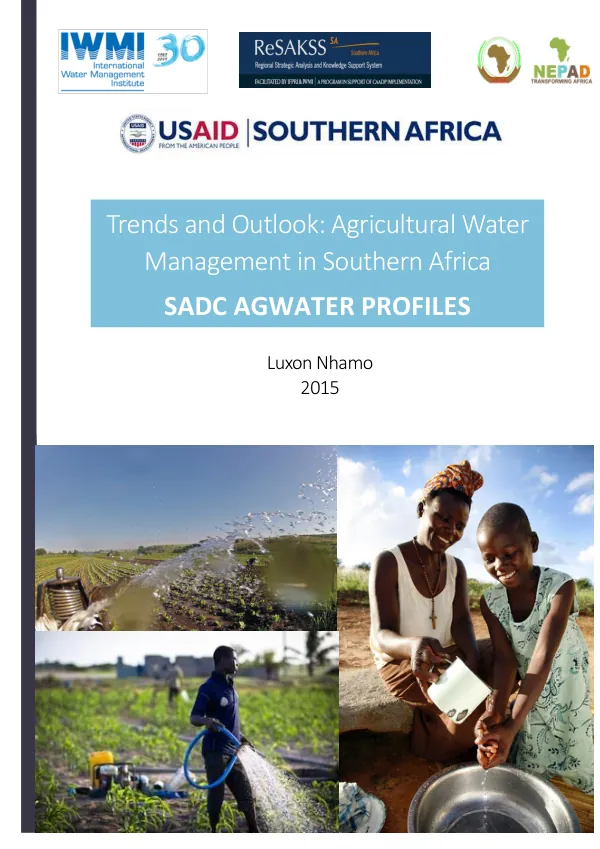
Trends and Outlook: Agricultural Water Management in Southern Africa
The Southern Africa Development Community (SADC) Agriculture and Water (AgWater) Profiles report is a comprehensive study on agricultural water management in the region.
2015 · 55 pages
Sign in to readA free account is required to download.
Abstract
The report covers national agricultural water management in Malawi, South Africa, Zambia, and Zimbabwe, with a focus on regional trends and outlook. The research project is supported by the United States Agency for International Development's (USAID's) Feed the Future Program through USAID's Southern Africa Regional Program. The report collected data related to agriculture and water in all inland SADC countries from various sources, including consultants, FAO's Aquastat database, World Bank Development Indicators, and UNDP's Human Development Report 2014. The resulting country profiles synthesize national data on agriculture, water, land, and population, water resources, water withdrawals, water managed area, and agricultural production, as a basis for analyses of trends and outlook on agricultural water management. The report highlights the irrigation potential of SADC countries, with South Africa having the highest irrigation potential of 1,500,000 hectares, followed by Mozambique with 3,070,000 hectares. The report also presents data on water use in Southern Africa countries, with Angola having the highest mean annual rainfall of 1,052 millimeters and the highest annual renewable water resource of 184,000 cubic meters. The Angola Water and Agriculture Profile provides detailed information on the country's agricultural sector, including total population, total surface area, population density, economically active population, and agricultural population. The report also presents data on agricultural land, arable land, arable and permanent cropland, area under cereal production, average precipitation, internal dam capacity, irrigation potential, total water withdrawal, and area equipped for irrigation. The report highlights the importance of water resources in Angola, with a total renewable water resource of 148 cubic meters per year and a total dam capacity of 9.445 cubic kilometers. The report also presents data on water withdrawal, including agricultural water withdrawal, municipal water withdrawal, industrial water withdrawal, and total water withdrawal. The report concludes that Angola has a high dependency ratio, with a total renewable water resource per capita of 7,108 cubic meters per year. The report also presents data on water managed area, including full coverage of water managed area, surface water withdrawal, groundwater withdrawal, total freshwater withdrawal, and desalinated water produced. The report highlights the importance of water management in Angola, with a total freshwater withdrawal of 0.7058 cubic kilometers and a total water managed area of 569,400 hectares. The report concludes that the SADC region faces significant challenges in agricultural water management, including limited irrigation potential, high water withdrawal rates, and limited water managed area. The report recommends that the SADC region should prioritize water conservation and efficient use of water resources to meet the increasing demands of agriculture, industry, and municipalities.