USAID DEC
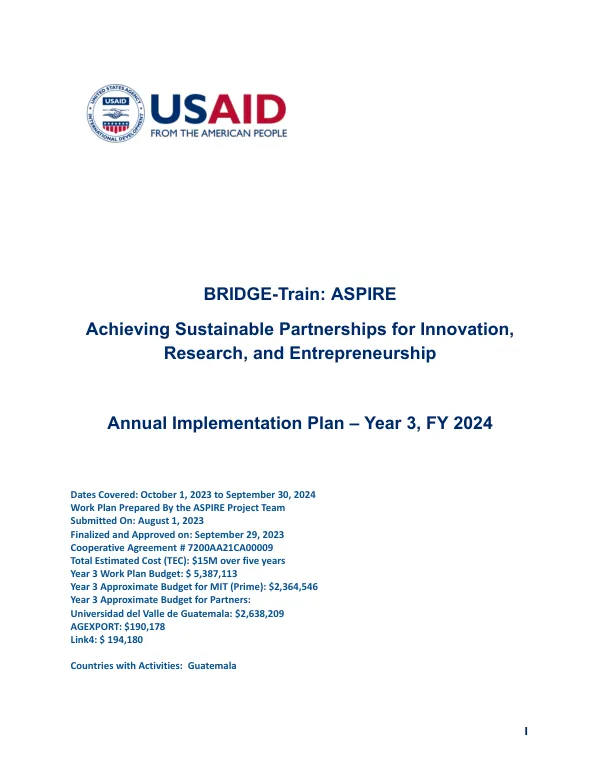
Annual Implementation Plan – Year 3, FY 2024: Achieving Sustainable Partnerships for Innovation, Research, and Entrepreneurship
Sign inMASSACHUSETTS INSTITUTE OF TECHNOLOGY D-LAB
Annual Implementation Plan – Year 3, FY 2024: Achieving Sustainable Partnerships for Innovation, Research, and Entrepreneurship
The ASPIRE project is a joint initiative between the Massachusetts Institute of Technology (MIT) and the Universidad del Valle de Guatemala (UVG) and the Guatemalan Exporters Association (AGEXPORT) in Guatemala.
2024 · 67 pages
Sign in to readA free account is required to download.
Abstract
The project aims to leverage existing assets and bring together new methods, ideas, and collaborators to expand the innovation, research, and entrepreneurship capacity of higher education institutions in Latin America. The ASPIRE project is guided by four key objectives, which are in alignment with the objectives described in the STIP APS (Science, Technology, Innovation and Partnership Annual Program Statement) BRIDGE-Train Addendum. The objectives are: 1) TRAINING: Build the capacity of faculty, researchers, and staff at UVG and at MIT to provide world-class training on the generation and use of research and innovation for development; 2) RESEARCH, INNOVATION & ENTREPRENEURSHIP: Strengthen capacity to conduct high-quality research and research-driven innovation that is relevant to addressing local and regional challenges; 3) PARTNERSHIP, TECH TRANSFER, & UPTAKE: Create a replicable model for uptake of university research by companies that originated in the university and other private and public sector partners; and 4) CULTURE & SYSTEMS: Create a university culture and administrative and research systems supportive of innovation and entrepreneurship. The project will adopt the CREA communication model as part of its endeavor to create the "Research Innovation Lab," which will integrate ASPIRE training and research activities under one umbrella. The Lab will not only consolidate training and research activities for better performance and sustainability, but also utilize CREA-like image and graphical communication approaches to more effectively engage with stakeholders, internal and external. This change is aimed at improving already-effective operations and to ensure sustainability. The stakeholder engagement plan identifies a total of 19 stakeholder groups, 11 end-user and eight project level groups. Project staff engages with each group based on a set of 6 factors including: 1) Name of stakeholder group, 2) Interests, 3) Engagement strategies, 4) Frequency, 5) Who communicates, and 6) Collaboration. The plan aims to ensure that the project intentionally interacts with its stakeholders within the framework of a general engagement plan. The ASPIRE project has a total estimated cost of $15M over five years, with a Year 3 work plan budget of $5,387,113. The project will be implemented in Guatemala, with activities focused on building the capacity of faculty, researchers, and staff at UVG and at MIT, strengthening capacity to conduct high-quality research and research-driven innovation, creating a replicable model for uptake of university research, and creating a university culture and administrative and research systems supportive of innovation and entrepreneurship. The project will generate greater knowledge and understanding about practical, participatory approaches to local development challenges based on its experience during implementation and share them with higher education institutions and other organizations regionally. The project aims to create models which can be replicated by higher education institutions and their collaborators in the private sector, government, and local communities to address local and regional development challenges.
Related documents