USAID DEC
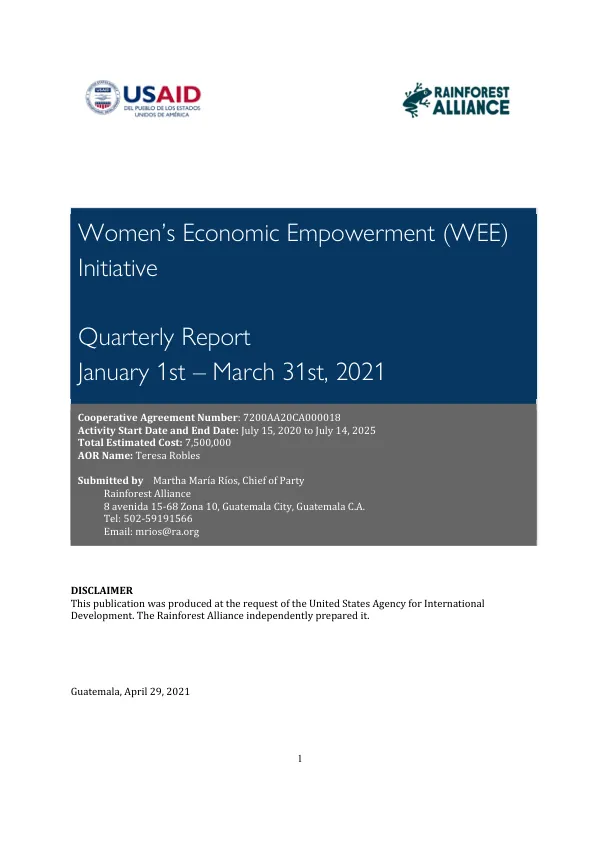
Women's Economic Empowerment (WEE) Initiative Quarterly Report January 1st – March 31st, 2021
Sign inRAINFOREST ALLIANCE
Women's Economic Empowerment (WEE) Initiative Quarterly Report January 1st – March 31st, 2021
Women's Economic Empowerment (WEE) Initiative in Guatemala began in July 2020 with a total estimated cost of 7,500,000 USD.
2021 · 31 pages
Sign in to readA free account is required to download.
Abstract
The initiative aims to promote women's economic empowerment through various activities and interventions. The quarterly report for January 1st to March 31st, 2021, highlights the progress made during the second quarter of fiscal year 2021. During this quarter, the Activity trained more than 1,000 women on topics such as leadership, basic entrepreneurship skills, livelihood development, organization and associativity, quality and marketing standards, agricultural sustainability practices, workshops on the Most Significant Change (MSC) methodology, and gender awareness training. Many women advanced business ideas in relevant value chains in their regions and were empowered to engage actively in business leadership activities and forums at the community, municipal, and regional level. The Advisory Committee was established and will hold its first meeting on May 4, 2021. The methodological framework for the Activity Baseline Study has been developed, including socioeconomic and gender indicators, to begin the collection of information during the third quarter. The Activity also conducted two socializations of the Gender Analysis main results, one within RA with the country directorates of the Activity and the second with the technical staff of the local and regional sub-awardees organizations. The reflections of the technical staff helped in the initial development of the Women's Empowerment Business Development Approach (WEBDA). The Activity also reported progress in the development of Initial Environmental Assessment (IEA) and updating of the Senior Advisory Committee. The financial report for the quarter shows a total expenditure of 1,500,000 USD, with 75% of the funds allocated to program activities. The Women's Economic Empowerment (WEE) Initiative has made significant progress in promoting women's economic empowerment in Guatemala. The Activity has trained over 1,000 women on various topics, including leadership, entrepreneurship, and agricultural sustainability practices. Women producer groups have reported significant sales, including $10,343 in egg sales and $1,132 in chicken sales. The Activity has also established business networks on poultry, orchards, and sheep breeding, with the participation of 89 women in Santa Eulalia, San Miguel Acatán, and San Rafael La Independecia, Huehuetenango. The Alliance of Women in Coffee (AMUCAFE) in Honduras has made arrangements to participate in the shipment of eight samples of green coffee, complying with all the norms and requirements in support of the Taiwanese Trade Office for Central America (CATO). The WEE Initiative has also made progress in the development of the Women's Empowerment Business Development Approach (WEBDA) and the methodological framework for the Activity Baseline Study. The Activity has established a strong partnership with local and regional sub-awardees organizations, and the Advisory Committee has been established to provide guidance and support to the Activity. The Activity has also reported progress in the development of Initial Environmental Assessment (IEA) and updating of the Senior Advisory Committee. The financial report for the quarter shows a total expenditure of 1,500,000 USD, with 75% of the funds allocated to program activities. The Activity has made significant progress in promoting women's economic empowerment in Guatemala, and the next quarter will focus on building on this progress and addressing the challenges and priorities identified in the report.