USAID DEC
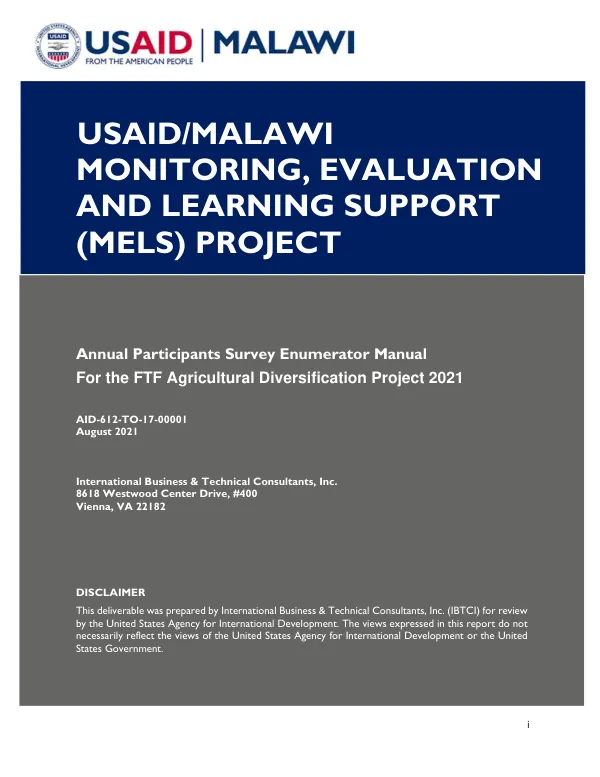
Annual Participants Survey Enumerator Manual For the FTF Agricultural Diversification Project 2021
Sign inINTERNATIONAL BUSINESS AND TECHNICAL CONSULTANTS, INC.
Annual Participants Survey Enumerator Manual For the FTF Agricultural Diversification Project 2021
The FTF Agricultural Diversification Project in Malawi began in 2018 with funding from the United States Agency for International Development (USAID).
2021 · 67 pages
Sign in to readA free account is required to download.
Abstract
The project aimed to improve agricultural productivity and income for smallholder farmers, particularly women and youth. The project's geographic focus was on the districts of Ntcheu, Dedza, and Machinga in Central and Southern Malawi. The project's monitoring, evaluation, and learning support (MELS) project conducted an annual participants survey in 2021 to assess the project's progress and impact. The survey was designed to collect data on various aspects of the project, including agricultural practices, income, and women's empowerment. The survey consisted of several modules, including informed consent, household identification, value chains, natural resources and ecosystem management, women's empowerment in agriculture, and female consumption of a diet of minimum diversity. The survey was implemented using a tablet-based system, with enumerators responsible for conducting the interviews and entering the data. Enumerators were required to follow a set of guidelines and instructions to ensure high data quality. The guidelines covered topics such as approaching the household, building confidence, translations, and asking questions. Enumerators were also responsible for reporting to the field supervisor, following up on missed interviews, and ensuring that the data was entered correctly on the tablet. The survey modules were designed to collect data on various aspects of the project. Module A collected data on the household's involvement in agricultural diversification activities, while Module B collected data on the participants' identification. Module D collected data on natural resources and ecosystem management, while Module E collected data on women's empowerment in agriculture. Module F collected data on female consumption of a diet of minimum diversity, and Module G collected data on GPS area measurement of value chain fields. The survey also included a module on informed consent, which was designed to ensure that participants understood the purpose and scope of the survey. The informed consent module explained the benefits and risks of participating in the survey and obtained the participant's consent to proceed with the survey. The survey was designed to be administered on a tablet, with enumerators responsible for entering the data and navigating through the modules. The tablet had various components, including a navigation system, a response entry system, and a troubleshooting system. Enumerators were required to follow a set of instructions to administer the modules, including how to ask questions, enter responses, and deal with refusals. The survey was an important tool for the MELS project to assess the project's progress and impact. The data collected through the survey would be used to inform project decisions and improve the project's effectiveness in achieving its goals.