WORLD VISION
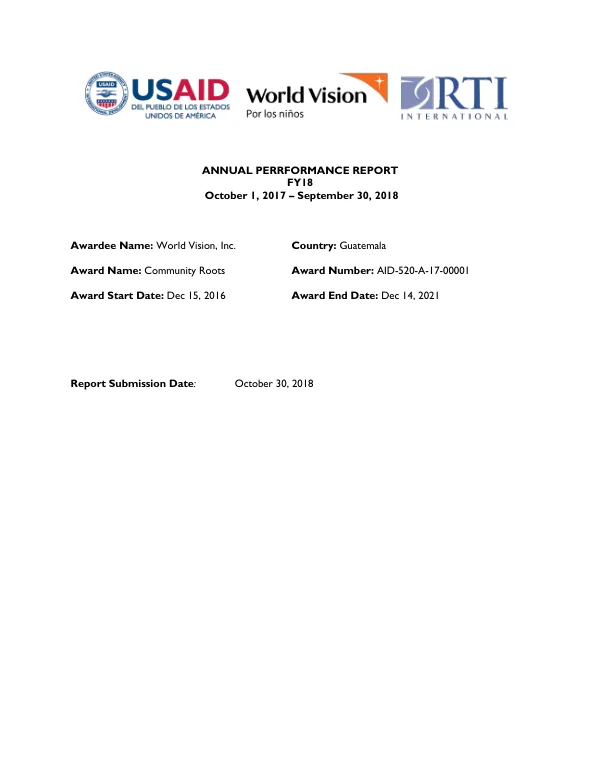
Annual Performance Report FY18
The Community Roots project in Guatemala, implemented by World Vision, Inc., aimed to support community-based commissions in promoting integrated violence and migration prevention initiatives in targeted areas.
2018 · 53 pages
Sign in to readA free account is required to download.
Abstract
The project operated in 20 municipalities, covering 80 communities, and was supported by three regional field teams and administrative and technical staff based in Guatemala City. During the period from October 1, 2017, to September 30, 2018, the project experienced a positive contextual implementation environment. Compared to the previous year, there were drops in violence in areas where the project was operating, including Coatepeque, Colomba Costa Cuca, San Juan Ermita, and San José La Arada. However, the numbers of border patrol apprehensions of families rose significantly, and the number of returning migrants increased in several departments. The project completed the baseline survey, which contained four main objectives: guiding community and municipal prevention commissions in identifying areas related to violence prevention and irregular migration, providing information to decision-makers, promoting private sector participation, and feeding inputs for services for high-risk youth enrolled in secondary prevention interventions. The project staff consolidated the territorial consolidation phase, which included buy-in from mayors, councils, community leaders, and community members. This phase laid the groundwork for sustainability through ample participation and transparency at the municipal and community levels. The project received certification from 50 communities through general assemblies, bringing the total to 80 communities supporting the project's implementation. Community and municipal actions and interventions were initiated in 79 communities and municipalities, with technical staff providing assistance and logistical support. The project's total number of participants in general assemblies reached 61,002, with 31,939 participants in 50 assemblies conducted in FY18. The project's implementation focused on three regional field teams, with offices in Chiquimula, Huehuetenango, and Malacatán, San Marcos. The field staff was supported by administrative and technical staff based in the World Vision Guatemala City Office. The project's geographic scope covered eight municipalities in Chiquimula, two municipalities in the southwestern coast of Quetzaltenango, and five municipalities each in San Marcos and Huehuetenango. The project's objectives included supporting community-based commissions, strengthening and mobilizing municipal and national stakeholders, promoting private sector involvement, and supporting secondary violence prevention projects. The project's implementation was guided by the principles of sustainability, transparency, and community participation. The project's monitoring, evaluation, and learning activities were conducted throughout the year, with a focus on tracking progress, identifying challenges, and making adjustments to the project's implementation. The project's gender and inclusion strategy aimed to ensure that all project activities were inclusive and equitable, with a focus on promoting the participation of women and other marginalized groups. The project's environmental compliance and communications strategies were also implemented, with a focus on ensuring that the project's activities did not harm the environment and that the project's messages and materials were communicated effectively to stakeholders. The project's security challenges and lessons learned were also documented, with a focus on identifying areas for improvement and making adjustments to the project's implementation. Overall, the Community Roots project in Guatemala made significant progress in FY18, with a focus on promoting community-based commissions, strengthening municipal and national stakeholders, and promoting private sector involvement. The project's implementation was guided by the principles of sustainability, transparency, and community participation, and the project's monitoring, evaluation, and learning activities were conducted throughout the year to track progress and make adjustments to the project's implementation.