MERCY CORPS INTERNATIONAL
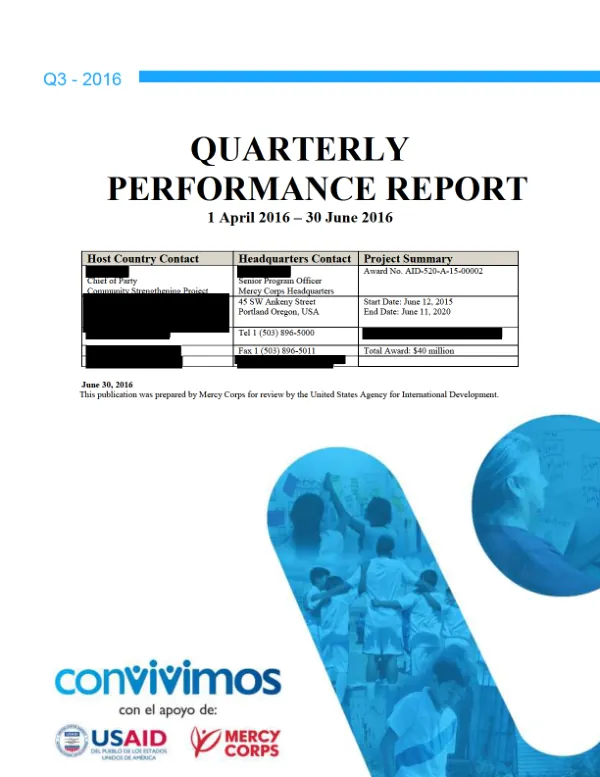
Final Report: Community Strengthening Project (CONVIVIMOS) in Guatemala
The Community Strengthening Project, now known as the CONVIVIMOS Program, is a $40 million violence prevention program funded by the United States Agency for International Development (USAID) and implemented by Mercy Corps in Guatemala from 2015 to 2020.
2016 · 39 pages
Sign in to readA free account is required to download.
Abstract
The program aims to support the government of Guatemala, municipalities, civil society, and community actors in addressing the causes and consequences of violence through integrated prevention techniques. CONVIVIMOS focuses on four complementary and mutually reinforcing objectives: supporting community commissions to institutionalize proven, integrated violence prevention projects in targeted areas; strengthening and mobilizing municipal and national stakeholders and resources to develop and implement municipal-level violence prevention plans; supporting youth violence prevention activities in coordination with municipal authorities; and promoting and integrating evidence-based policy making among violence prevention actors. The program targets 80 urban communities with the highest homicide rates in Guatemala, including municipalities in Guatemala City, Amatitlan, Mixco, and Villa Nueva, with a focus on youth. CONVIVIMOS works in close coordination with national and municipal governments, engaging many civil society and private sector stakeholders to maximize and sustain impacts. The program addresses both the underlying drivers of chronic violence and more immediate trigger factors tied to youth exclusion from education and economic opportunities. CONVIVIMOS promotes a multi-stakeholder, municipal, and community-level prevention model focused on demand-driven interventions, reinforced by civil society. The program is based on the theory that strengthening the capacities of individuals, families, communities, and government will result in an increase in community resilience, leading to a safer and more secure society. During the reporting period of April-June 2016, CONVIVIMOS implemented a strategy to continue consolidating relationships with strategic actors and partners at the community, municipal, and national levels, as well as among civil society organizations and academic institutions notable for their experience in violence prevention. The program signed coordination agreements with all four target municipalities and the Ministry of the Interior, and established coordination with the Governor of the Department of Guatemala, bringing structure and commitment to the project's technical approach and strengthening the program's influence in advocating for public and private investment and coordination toward violence prevention. The new Deputy Minister for Violence Prevention within the Ministry of the Interior and the new Deputy Director of Crime Prevention in the National Civilian Police are key allies for the program, with a long trajectory in the violence prevention sector. These partnerships are crucial in institutionalizing violence prevention in the new government and promoting a safer and more secure society in Guatemala. CONVIVIMOS has made significant progress in its first year, with over 2,500 community members participating in violence prevention activities, and more than 1,000 youth engaging in prevention programs. The program has also established a network of community leaders and stakeholders who are committed to promoting violence prevention in their communities. The program's focus on youth is critical in addressing the underlying drivers of chronic violence in Guatemala. By providing opportunities for youth to engage in prevention programs and promoting their participation in local development activities, CONVIVIMOS aims to reduce their likelihood of being drawn into violence and promote a safer and more secure society. Overall, CONVIVIMOS is a critical program in addressing the complex issue of violence in Guatemala. By working with community, municipal, and national stakeholders, the program aims to promote a multi-stakeholder, municipal, and community-level prevention model that addresses both the underlying drivers of chronic violence and more immediate trigger factors tied to youth exclusion from education and economic opportunities.
Related documents